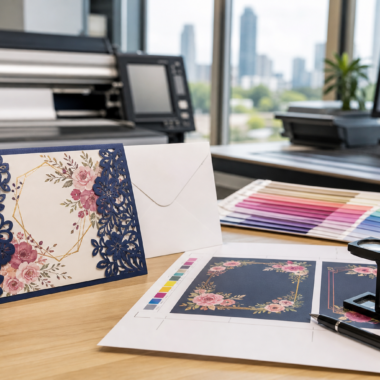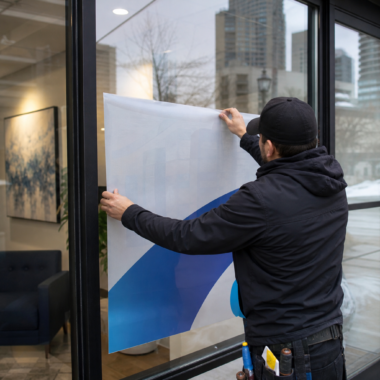
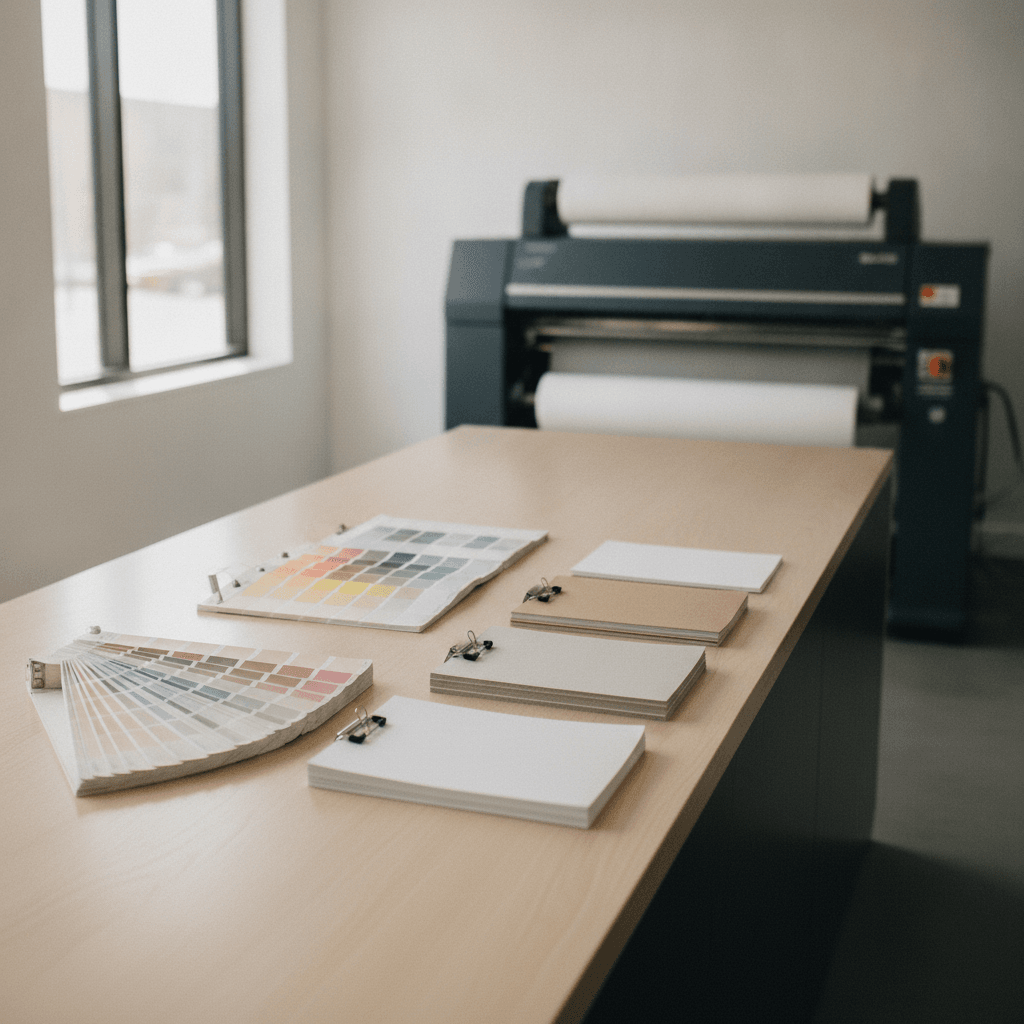
Custom printed marketing materials are brand-specific print pieces—like business cards, brochures, postcards, door hangers, and banners—produced to your specs for measurable results. The right mix drives local reach around the 5004 Timberlea Blvd Unit#18 area in Mississauga and beyond. For Realtors and small businesses, strong print reinforces listings, events, and neighborhood visibility—often the same day.
By Ashwani • Top Realtor Sign & Print
Last updated: 2026-06-29
Quick Summary and Table of Contents
This complete guide shows you how to choose, design, and order custom printed marketing materials that perform—without reprints or delays. You’ll learn file setup specs, finish options, signage choices for listings and events, and a same-day pickup workflow tailored to Mississauga professionals.
- What custom printed marketing materials include and when to use each
- Why print still converts in 2026 (plus size, bleed, DPI, and color facts)
- Step-by-step print workflow from brief to pickup
- Formats and finishes for business cards, brochures, postcards, and signs
- Best practices to avoid artwork rejects and last-minute stress
- Tools and resources to accelerate design and approvals
- Real Mississauga case studies for Realtors and local businesses
- Pricing and timeline factors (no numbers, only what affects them)
What Are Custom Printed Marketing Materials?
Custom printed marketing materials are intentionally designed, on-brand print pieces—cards, brochures, postcards, door hangers, folders, stickers, table tents, notepads, banners, and real estate signs—tailored to your audience and specs. They use correct sizes, stocks, finishes, and colors to create local awareness, generate leads, and support sales activity.
For Realtors and Ontario businesses, the core set includes:
- Business cards (standard 3.5″ × 2″) with premium options like soft touch, raised spot UV, and foil.
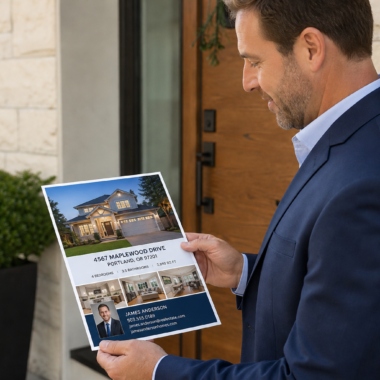
- Flyers and folded brochures (half-fold, Z-fold, tri-fold) that summarize listings, services, or offers.
- Postcards (often on sturdy 14pt stock) for neighborhood mail drops and leave-behinds.
- Door hangers with a clean 0.125″ bleed for tight edges and scannable QR placement.
- Presentation folders to bundle CMAs, disclosures, or proposal packets.
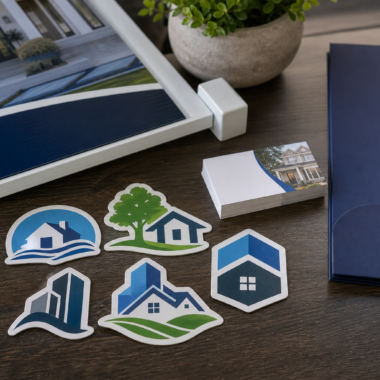
- Stickers and table tent cards for events or waiting areas.
- Notepads and realtor calendars for everyday brand presence.
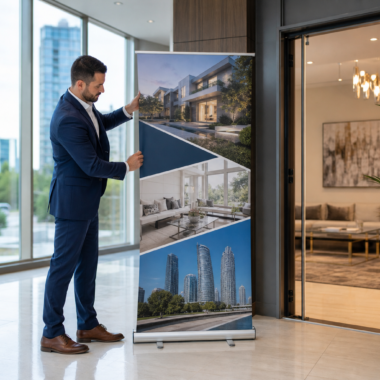
- Large-format assets like roll-up banners (commonly 33″ × 81″) for lobbies and showings.
- Real estate signage: For Sale, Open House, Directional signs, plus custom riders and inserts.
We produce these daily for agents around Mississauga and the GTA, and we’ve found the right combination depends on audience, channel, and timeline. If you need help deciding, our in-house design team can map pieces to your goals in one planning call.

Why Custom Print Still Matters in 2026
Print anchors local trust. Physical pieces reach households without algorithms, support events, and stay visible for weeks. Correct specs—300 DPI images, CMYK color, and 0.125″ bleeds—ensure sharp, accurate output that makes your brand credible at first glance and memorable over time.
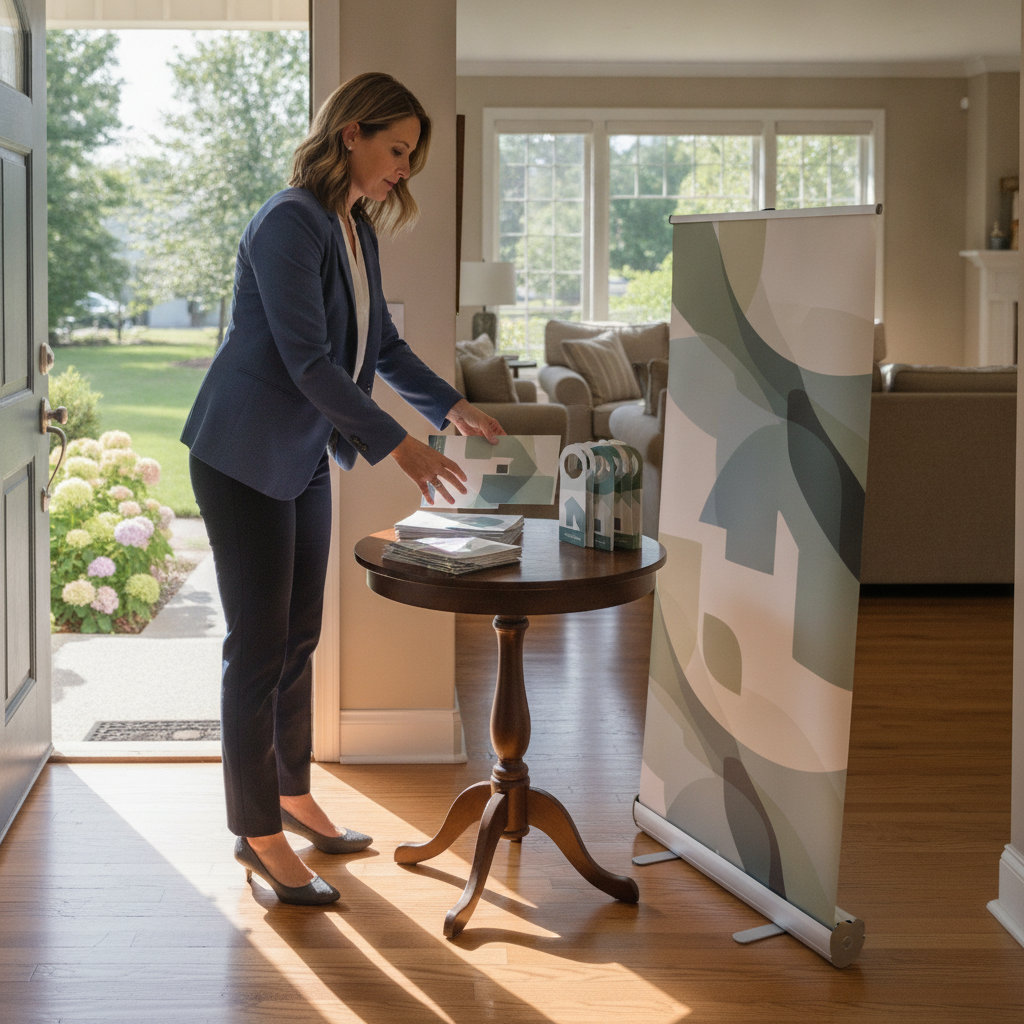
- Local presence outlasts a post: A 33″ × 81″ roll-up banner at an open house delivers hours of on-site visibility. Door hangers can sit on the handle for days.
- Tactile recall: A soft touch business card with raised spot UV creates a multi-sensory cue your phone screen can’t duplicate.
- Brand control: CMYK builds (e.g., 60/40/40/100 for rich black) and vector logos keep color and edges consistent across reorders.
- Neighborhood targeting: 4″ × 6″ postcards are sized for direct mail routes and community events.
- Compliance and clarity: Proper contrast ratios and legible font sizes (at least 8–9 pt for body copy) improve readability and reduce reprints.
Here’s the thing: print isn’t competing against digital—it’s completing it. A scannable QR on a 5.5″ × 8.5″ flyer bridges offline and online, lifting landing-page visits the same weekend you canvass.
How the Custom Print Process Works (Brief to Pickup)
Successful print follows a predictable path: clarify goals, finalize content, design to spec, proof, preflight, print, finish, and pick up. Using 300 DPI, CMYK, and 0.125″ bleeds prevents rejects. Same-day pickup works when art is approved by morning and stocks are on hand.
- Discovery: Audience, purpose, quantities, format (e.g., 4″ × 9″ door hanger vs. 4″ × 6″ postcard).
- Content & brand: Headlines, copy, offers, QR/URL, brokerage-compliant branding.
- Design: Layout at final size + 0.125″ bleed; 0.25″ safe margin; vectors for logos; images at 300 DPI.
- Proof: PDF or hard proof; confirm trims, folds, panel order, and finish placements (e.g., raised UV zones).
- Preflight: Convert to CMYK; embed fonts; outline type; check ink coverage & overprint; add dielines on separate spot colors if needed.
- Production: Digital press for short runs and speed; large-format for banners and signs; screen printing for specialty substrates.
- Finishing: Trim, score, fold, bind, laminate, foil, paint edges; QC for scuffs and alignment.
- Pickup/Delivery: Same-day pickup when art is approved early and stock is available; local Mississauga routing.
| Step | Spec to Check | Typical Number | Common Pitfall |
|---|---|---|---|
| Design Size | Final + Bleed | +0.125″ on all sides | Artwork built at trim, no bleed |
| Resolution | Raster images | 300 DPI at size | 72 DPI web images placed |
| Color | Color mode | CMYK process | RGB colors shift on press |
| Safety | Edge margin | 0.25″ safe area | Text too close to trim |
| Fonts | Output handling | Embed/Outline | Missing font substitution |
| Proofing | Approval rounds | 1–2 passes | Skipping page order checks |
Want a shortcut? Our team can preflight your files and flag issues in minutes, then suggest the fastest path to pickup based on quantity, stock, and finishing.
Types of Materials and Approaches That Work
Match format to job: cards for introductions, brochures for depth, postcards and door hangers for routes, folders for proposals, stickers and table tents for in-person prompts, banners for events, and real estate signs for location authority. Each has ideal sizes, finishes, and distribution tactics.
Business cards that people keep
- Stocks: Standard cover, thick premium, or soft touch lamination for a matte, velvet feel.
- Finishes: Raised spot UV for logos; gold/silver foil; painted edges for a bold stack effect.
- Specs: 3.5″ × 2″; 0.125″ bleed; 0.25″ safe margin; vector icons for crisp lines.
- Pro tip: Use one clear CTA and a short URL or QR to a trackable page.
Ready to upgrade cards for your next brokerage meeting? Explore inspiration in our design portfolio and see how premium finishes translate in real projects.
Flyers and folded brochures for depth
- Sizes: 5.5″ × 8.5″ or 8.5″ × 11″ flyers; tri-fold brochures at 8.5″ × 11″ with panel planning.
- Folds: Half, Z, tri-fold; score heavier stocks to prevent cracking.
- Use cases: Open houses, service menus, neighborhood education, event handouts.
- Detail: Ensure interior panels add to exactly 11″; avoid panel creep by measuring live copy boxes.
When turnarounds are tight, our brochure printing guide explains how to move from proof to pickup fast—without skipped checks.
Postcards and door hangers for routes
- Postcards: Popular at 4″ × 6″ or 5.5″ × 8.5″ on sturdy 14pt; leave 2.625″ × 4″ clear zones if mailing with indicia.
- Door hangers: 4″ × 9″ or 3.5″ × 8.5″ with centered die-cut; watch for handle clearances on narrow knobs.
- Tip: Group routes by street count; plan 10–15 seconds per drop to batch time estimates.
Need a content idea? Highlight three service wins with numbers (e.g., “12 showings first weekend,” “3-day close,” “97% list-to-sale”). Short and scannable wins.
Presentation folders, stickers, table tents, and notepads
- Folders: 9″ × 12″ with 4″ pockets; include a business card slit; keep spine text orientation consistent.
- Stickers: Durable laminate for outdoor use; vector dielines on spot color named “CutContour.”
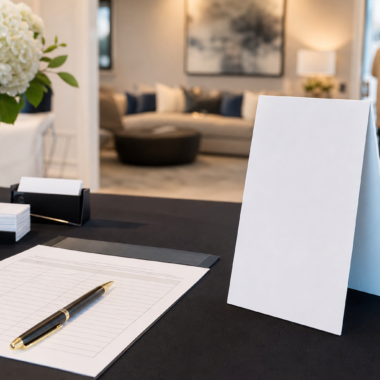
- Table tents: 4″ × 6″ or 5″ × 7″; make the base ample so they stand after many touches.
- Notepads: 25 or 50 sheets; add a faint 5–10% tint grid or checklist to increase utility.
See sample structures and panel ideas in our graphics portfolio and brochure product page for fold diagrams.
Large-format and event signage
- Roll-up banners: Commonly 33″ × 81″; keep headlines above 36″ so they clear furniture; 150 DPI is fine at size.
- A-frames: 24″ × 36″ inserts; test for wind; sandbag at curbside corners.
- Yard signs: Coroplast at 4 mm thickness with H-stakes; consider 24″ × 32″ for wider drive-by read.
We routinely stage banners and A-frames for Saturday showings; a quick walk-around at setup catches glare, crooked stakes, and blocked sightlines.
Realtor signage that sets the tone
- Core pieces: For Sale signs, Open House signs, Directionals, custom riders, and inserts.
- Readability: A good rule of thumb is 1″ of letter height per ~25 feet of viewing distance.
- Durability: UV inks and laminates improve outdoor lifespan; verify grommet placement and post hardware.
Want examples mapped to actual listing workflows? Browse our design portfolio and see how we combine Open House, Directionals, and riders for cohesive weekend coverage.
Best Practices to Avoid Reprints and Delays
Prevent issues by designing at final size with 0.125″ bleeds and 0.25″ safe margins, using CMYK and vector logos. Proof twice, place QR codes at least 0.8″ square, and keep minimum body text at 8–9 pt. For banners, set headlines high and contrast ratios strong.
Design and layout
- Build to spec: Final size + 0.125″ bleed; include fold guides on a non-printing layer.
- Type: Body 8–10 pt; headlines 24–48 pt depending on format; keep max 65–75 characters per line.
- Margins: 0.25″ safe area prevents trim loss; for thick folders, increase to 0.375″.
- QR placement: At least 0.8″ square with quiet zones; test from arm’s length.
Color and imagery
- Mode: CMYK builds; avoid RGB to prevent on-press shifts.
- Rich black: Common build 60/40/40/100 for solids; keep total ink under 300% for coated stocks.
- Photos: 300 DPI at size; avoid upscaling low-res MLS images.
Finishes and substrates
- Soft touch: Matte, non-glare, fingerprints minimized—great for first impressions.
- Raised spot UV: Use sparingly to highlight logos or accents; avoid over large text blocks.
- Foils: Gold or silver foils reinforce premium brands; align with brokerage palettes.
- Coroplast & PVC: 4 mm coroplast for temporary outdoor, 3–6 mm PVC for durable indoor signs.
Need a fast gut check on artwork? Share files, and we’ll preflight and return notes the same day when timelines are tight.
Tools and Resources to Speed Approvals
Leverage templates, our browser-based design support, and fast preflight to cut days off turnaround. Use checklists, mockups, and QR testing to validate content. Learn from marketing playbooks to avoid mixed messages and keep one clear ask per piece.
- Online design support: Create print-ready layouts in your browser without specialized software—perfect for quick updates.
- Reusable templates: Lock brand elements so only headline, photos, and CTA change per listing.
- Preflight checklist: CMYK, 300 DPI, 0.125″ bleed, 0.25″ safe, outlined text, embedded images.
- Learn from content pros: See common pitfalls in top content mistakes and align each print piece to a single, simple CTA.
- For real estate media: A useful overview of creative assets is outlined in this real estate media guide—helpful when planning photography for brochures and postcards.
- Brand inspiration: Review our graphics portfolio to see real finishes, folds, and panel strategies before you commit.
Want deeper B2B messaging guidance? Skim a practical list of B2B content mistakes to avoid and mirror the focus in your offline materials.
Request a quick print planning consult
Share your goal, audience, and deadline. We’ll suggest formats, finishes, and a proofing plan you can approve fast. Local pickup keeps listings and events on schedule.
Mini Case Studies: What Works Around Mississauga
Three quick wins: a same-day flyer set for a Saturday open house, premium cards that boosted referral conversations, and a banner-plus-directional kit that streamlined wayfinding. All three followed tight specs, clear CTAs, and fast approvals.
- Saturday open house kit: By Friday noon, we finalized a 5.5″ × 8.5″ flyer, 4″ × 9″ door hanger, and 24″ × 36″ A-frame inserts. The agent canvassed a 120-home route in 2 hours and had pieces staged by 9:30 a.m.
- Premium business card refresh: A soft touch + raised UV combo, with a 0.8″ QR, increased scan rates at brokerage mixers. Cards stayed scuff-free in pockets through weekend tours.
- Banner + directionals: A 33″ × 81″ roll-up banner anchored the foyer while three 24″ × 18″ directionals guided traffic from the main road. Clear arrows and 1.5″ headline strokes improved at-a-glance reads.
For more structural ideas and folds, check our brochure page and design portfolio for live examples.
Pricing and Timeline Factors (No Numbers)
Budget and speed depend on quantity, stock weight, finish complexity, and proof cycles—more ink, thicker stocks, and special finishes add steps. Same-day pickup favors digital runs, in-stock materials, and clean, approved artwork by morning.
- Quantity & imposition: Higher counts change press choice and finishing paths; batching saves time when sizes nest efficiently.
- Stock & finishes: Soft touch, raised UV, foils, and painted edges add QA checkpoints and curing time.
- Format: Multi-panel brochures need scoring; stickers need dielines and kiss-cut checks.
- Artwork readiness: CMYK, 300 DPI, bleeds, and outlined fonts accelerate preflight—revisions add rounds.
- Pickup windows: Approve early for same-day; align with Mississauga traffic patterns for smooth afternoon collection.
You don’t need to memorize the workflow—share your timeline, and we’ll recommend the fastest viable sequence without sacrificing finish quality.
Custom Printed Marketing Materials: FAQ
These quick answers resolve the most common setup and turnaround questions for custom printed marketing materials—file specs, speed-to-pickup, finish durability, and which signs to stage for listings and events in the Mississauga area.
What file setup prevents delays or rejects?
Design at final size with a 0.125″ bleed, use CMYK, keep images at 300 DPI, embed or outline fonts, and leave a 0.25″ safe margin. Provide dielines on a separate spot color for stickers and shaped pieces. Send a flattened PDF proof for confirmation before production.
How fast can I get same-day pickup?
Same-day works when artwork is approved early, stocks are in-house, and finishing is straightforward. Short digital runs are fastest. Share deadlines upfront so we can schedule press time, preflight promptly, and confirm your pickup window without surprises.
Are soft touch, foil, and raised spot UV durable?
Yes—soft touch resists fingerprints, and foils and raised spot UV hold up well when applied to the right stocks. We add QA checks to avoid scuffs and alignment drift. Store cards in a case and avoid direct abrasion to preserve edges and finishes.
Roll-up banner or poster—what should I bring to a showing?
Bring a 33″ × 81″ roll-up banner for repeated setups because it packs small, stands fast, and stays upright. Posters are great on walls or easels but need accessories. Keep headlines above 36″ and use high contrast for quick reads during walk-throughs.
Which realtor signs should I stage for a new listing?
Start with a For Sale sign at the property, add Directionals at key turns, and use Open House signs on event day. Confirm letter heights (about 1″ per ~25 feet of viewing) and secure hardware. Riders help add status (“Just Listed”, “Sold”), URLs, or specific features.
Local considerations for 5004 Timberlea Blvd Unit#18
- Plan same-day pickups around traffic near Tomken Road; staging materials early helps if you’re routing via Tomken Station East Platform A for public transit connections.
- Weekend open houses draw dog-walk traffic near Parkway Belt Dog Park; door hangers and A-frames placed before 9 a.m. capture morning footfall.
- Outdoor signs face wind tunnels between buildings; add sandbags to A-frames and choose 4 mm coroplast for temporary yard placements.
Conclusion and Next Steps
Align message, format, and specs, and your print won’t just look good—it will move people to act. Use CMYK, 300 DPI, and proper bleeds; keep one clear CTA; and plan approvals early. That’s how you meet tight windows and make every piece count.
Key takeaways
- Design to print specs: 300 DPI, CMYK, 0.125″ bleed, 0.25″ safe margins.
- Map each piece to purpose: introduce, explain, route, or convert.
- Use premium finishes where touch matters most—often your card.
- Stage signs with legible letter heights and clear sightlines.
- Approve early to unlock same-day pickup and smooth weekends.
Ready to plan your next batch of custom printed marketing materials? Book a quick discovery session in the 5004 Timberlea Blvd Unit#18 area, and we’ll outline formats, timelines, and finishes you can put to work this week.
Related Articles & What to Explore Next
Deepen your print results by reviewing fold diagrams, finish samples, and real project photos. Comparing a few live layouts often clarifies copy positions, QR sizing, and where premium finishes create the most impact for your audience.
On our site, explore portfolio examples of brochures, folded panels, and signage kits to see how consistent type scales, color builds, and finish placements look in the real world—before you finalize your next order.