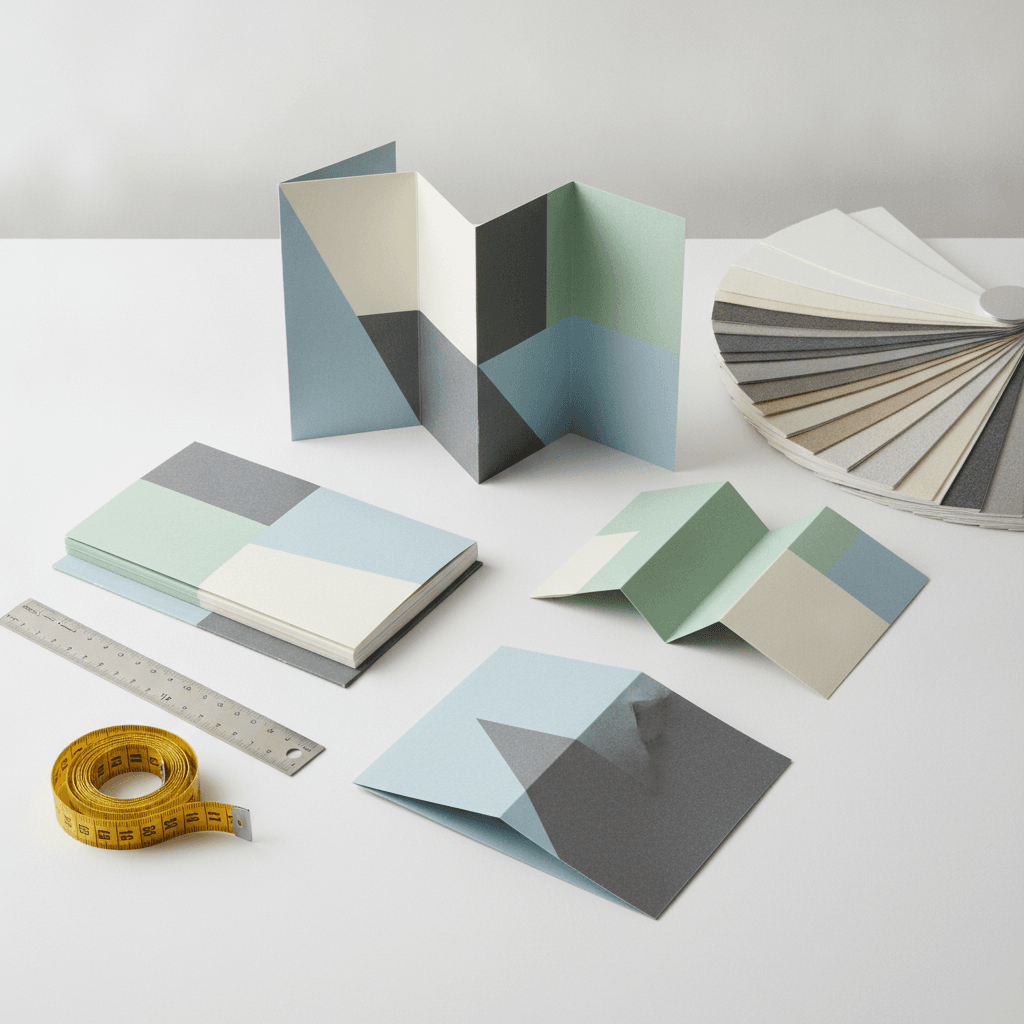
Folded brochure sizes for listings are the standard page dimensions and fold layouts used to present property details in a compact, skimmable format. Typical options include tri-fold 8.5 × 11 inches, half-fold 11 × 17 inches, and z-fold 8.5 × 14 inches. For Mississauga agents in the Timberlea Blvd area, the right size speeds design, printing, and same-day pickup.
By Ashwani • Top Realtor Sign & Print
Last updated: 2026-06-25
Overview
Listing brochure sizes determine how much content you can show, how panels align after folding, and whether your design meets print specs. Choose a size that matches your photos and copy, keeps margins safe, and supports fast production for open houses and new listings.
Use this complete guide to pick the right folded brochure sizes for listings, set up print-safe files, and move from proof to pickup quickly. It’s written for Realtors and marketers printing with Top Realtor Sign & Print in Mississauga.
- Clear definitions of standard brochure dimensions and folds
- Panel math, margins, bleeds, and DPI you can copy-paste
- Real estate–specific layout tips and examples
- Printable size table and fold diagrams explained in words
- Local notes for Mississauga open houses and same-day pickup
What are folded listing brochures?
A folded listing brochure is a single sheet that’s creased into panels (tri-fold, z-fold, half-fold, gate, or roll) to organize property photos and copy. Standard finished sizes use North American letter and tabloid dimensions so panels align cleanly and print shops can deliver quickly.
At Top Realtor Sign & Print, most real estate teams use brochures as handouts next to their For Sale signs, leave-behinds after showings, or inserts in listing packets. The folds create predictable panel “stories” so buyers scan features, floor plans, and calls to action without effort.
- Single sheet construction: Lower cost per unit and faster production compared to multi-page booklets.
- Panelized storytelling: Front cover draws interest; inside panels expand; back panel handles contact/branding.
- Standard substrates: Common weights run 100–170 gsm text or 10–16 pt cover; heavier stocks feel premium.
- Local use cases: Open houses, community canvassing, model home displays, or brokerage info packs.
When you keep sizes standard, our team can turn same-day pickups for select items, coordinate with your brochure order, and align artwork with your flyers or preferred flyer sizes.
Why brochure size matters in real estate
Brochure size controls readability, print speed, mailing fit, and how well panels line up after folding. Pick a size that matches your media (MLS photos, floor plans) and the way buyers skim, so your strongest selling points land on the most visible panels.
The wrong size forces tiny type, cropped photos, or awkward panel joins. The right one supports consistent margins, clean folds, and faster approvals from your broker. In our experience with Mississauga agents, crisp 10–12 pt body text and 0.25–0.375 inch safe margins prevent most late-game edits.
- Skimmability: Buyers typically scan headlines first, then captions, then details. Placing 3–5 benefits above the fold helps.
- Production speed: Standard sizes run on house stocks, which shortens prepress and finishing.
- Panel math: Unequal panels on roll folds need precise widths to avoid “creep.”
- Distribution: Handouts fit pockets better at 3.66 × 8.5 inches (tri-fold finish); half-folds feel more like mini booklets.
Here’s the thing: a good fold guides attention. If the front cover sets a promise, the first inside panel should deliver proof—photo, stat, or floor plan—without crowding.
Standard brochure sizes and fold types
The most common real estate brochure formats use 8.5 × 11, 8.5 × 14, and 11 × 17 inch sheets. Tri-fold and z-fold finish at 3.66 × 8.5 inches, while half-fold finishes at 8.5 × 11. Gate and roll folds offer more drama but need tighter panel math and scoring.
Below is a quick-reference table you can use with your designer or our in-house team. Dimensions are before trimming and folding unless noted as “finished.” Keep bleeds at 0.125 inches on all sides and maintain consistent safe margins.
| Base Sheet | Fold Type | Finished Size (W × H) | Typical Panels | Notes |
|---|---|---|---|---|
| 8.5 × 11 in | Tri-fold | ≈ 3.66 × 8.5 in | 3 | Classic handout; inside center panel is hero space. |
| 8.5 × 14 in | Z-fold | ≈ 3.66 × 8.5 in | 3 | Opens accordion-style; great for step-by-step home features. |
| 11 × 17 in | Half-fold | 8.5 × 11 in | 2 | Poster-like inside spread; ideal for floor plans or comps. |
| 11 × 25.5 in | Roll fold (4-panel) | ≈ 5.66 × 11 in | 4 | Inside panel widths step down (e.g., −1/16 to −1/8 in). |
| 12 × 18 in | Gate fold | 6 × 9 in | 3 (2 gates + center) | Dramatic reveal; score lightly to prevent cracking. |
If you need fast approvals, start with a tri-fold 8.5 × 11 and a 6-panel outline: Cover, Story, Proof, Tour, Neighborhood, Contact. It prints quickly and pairs with your graphics assets and design templates.
How to choose the right size for your listing
Match size to content density. Use tri-fold 8.5 × 11 for fast handouts, half-fold 11 × 17 for big visuals and plans, and z-fold 8.5 × 14 for stepwise storytelling. Keep body text 10–12 pt, image resolution at 300 DPI, and margins at 0.25–0.375 inches.
Start from your assets
- Photo orientation: 11 × 17 half-fold favors two 10.5 × 8 inch hero images across the spread.
- Floor plans: Half-fold or gate fold keeps dimensions legible at 300 DPI without micro text.
- Feature lists: Tri-fold supports 3–5 bullet clusters across inside panels without crowding.
Consider distribution
- Open houses: Tri-folds slip into jacket pockets; half-folds feel more substantial.
- Door-to-door: Slim tri-folds reduce hand fatigue when canvassing a block.
- Brokerage packets: Half-folds sit neatly in standard folders alongside invitation pieces.
Think through your call to action
- Panel placement: Put QR and contact on the back panel, upper third, for quick scans.
- Contrast: 4.5:1 color contrast or better keeps numbers readable in low light.
- Consistency: Mirror design with your brand standards so signs, flyers, and brochures match.
Not sure? Share your assets and timeline. We’ll recommend a format and prep your file for fast pickup in Mississauga’s Timberlea Blvd area.
Design specs and print‑ready setup
Set brochures at 300 DPI with CMYK color, 0.125 inch bleeds, and 0.25–0.375 inch safe margins. Use precise panel widths for roll and gate folds, export as PDF/X-1a, and add crop marks outside the bleed. Score heavier stocks to prevent cracking.
- Document size: Build at full flat size (e.g., 8.5 × 11 for tri-fold) plus 0.125 inch bleed on all sides.
- Resolution: 300 DPI for photos; logos as vector where possible.
- Color: CMYK; avoid 100% black for large solids—use rich black like C40 M30 Y30 K100.
- Type: Body 10–12 pt, headings 18–28 pt; track −10 to 0 for headlines depending on font.
- Margins: Keep live content 0.25–0.375 inches from trim; add more near folds.
- Panels: On roll folds, reduce inner panel widths by 1/16–1/8 inch per step.
- Export: PDF/X-1a or PDF/X-4; embed fonts; include crop marks and 0.125 inch bleed.
When you’re ready, upload to the brochure product page or use our online design editor to place images, set bleeds, and generate a proof that our prepress can approve without back-and-forth.
Types of folds and where they shine
Tri-fold is the universal handout. Z-fold is best for step-by-step tours. Half-fold showcases big visuals. Gate fold delivers a reveal moment. Roll fold provides extra panels for features, neighborhoods, and testimonials without switching to a booklet.
Tri-fold (letter 8.5 × 11)
- When to use: New listings, open houses, quick handouts.
- Panel flow: Cover → highlights → proof → photo grid → map/amenities → contact.
- Tip: Make the inside center panel your hero image and stat block.
Z-fold (legal 8.5 × 14)
- When to use: Step-by-step “tour” narratives or feature progressions.
- Panel flow: Each panel stands alone; great for buyers who skim in chunks.
- Tip: Use arrows or visual cues to guide the sequence subtly.
Half-fold (tabloid 11 × 17)
- When to use: Floor plans, large comps map, or a before/after reno story.
- Panel flow: Poster-like two-page spread inside; cover/back outside.
- Tip: Keep inner gutters clear 0.25–0.375 inches to avoid fold clash.
Gate fold
- When to use: Luxury listings or launches where drama helps.
- Panel flow: Gates open to a striking centerpiece—staged living room or aerial.
- Tip: Score both gate edges; step panel widths by 1/16 inch to prevent overlap.
Roll fold (4‑panel)
- When to use: Long feature lists, neighborhood amenities, testimonials.
- Panel flow: Panels roll inward; inner-most must be the narrowest.
- Tip: Keep copy blocks short—35–55 words per panel improves scanability.
If you’re balancing brochures with signs, remember the pillar topic many ask about—what a rider sign is used for. Pairing the right rider message with the right brochure fold creates a cohesive on-site experience.
Best practices that prevent size mistakes
Lock size and fold before copywriting. Draft a 6‑panel outline. Place the strongest proof on the first inside panel. Keep safe margins generous, export a print‑ready PDF with bleeds and crop marks, and request a scored mockup when using heavy cover stocks.
- Decide format first: Commit to tri-fold, z-fold, or half-fold before writing.
- Outline panels: 6 headers, 6 bullets—then fill in details.
- Place proof early: Reviews, stats, or awards on the first inside panel build trust.
- Maintain hierarchy: H1 cover 22–32 pt; H2 panels 16–24 pt; body 10–12 pt.
- Check panel gutters: Leave 0.125–0.187 inch extra near folds.
- Ask for scoring: Stocks ≥ 12 pt should be scored before folding to prevent cracks.
- Soft proof, then hard proof: Review a PDF, then a printed sample for alignment.
We’ve found Realtors who follow a fixed panel outline approve designs in one round and pick up the same day for open houses near Mississauga’s Timberlea Blvd area.
Tools and resources for fast, accurate files
Use a browser-based editor for quick templates or pro tools for complex layouts. Save presets for 8.5 × 11 tri-fold, 8.5 × 14 z-fold, and 11 × 17 half-fold with 0.125 inch bleeds, then export PDF/X with embedded fonts for prepress.
- Our online editor: Build layouts directly on the brochure page; align panels, add bleeds, and export print-ready.
- Template library: Ask our team for Mississauga-ready templates matched to brokerage colors.
- Design references: For ad sizing mindset and proportions, see this dimensions cheat sheet.
- Inspiration: Compare leaflet vs. brochure flow using this advertising leaflet example.
- Distribution ideas: Pair print with social using this realtor social media guide.
If file setup isn’t your thing, our in-house designers can place assets, fix panel math, and hand you a ready-to-print PDF. You focus on showings; we’ll handle prepress.

Mini case studies: Mississauga listings
Sizing choices change outcomes. Tri-folds excel as pocket handouts; half-folds win when big visuals matter; z-folds guide stepwise tours. These three quick scenarios show how format affects readability, buyer engagement, and pickup timing in Mississauga.
Detached in East Credit: speed first
- Challenge: Twilight shoot delivered late; open house next morning.
- Choice: 8.5 × 11 tri-fold template; 6‑panel outline pre-saved.
- Result: One proof cycle; pickup before noon; consistent with existing flyer size.
Condo near Stanford International College: show the plan
- Challenge: Buyers asked for storage and layout clarity.
- Choice: 11 × 17 half-fold; full-spread floor plan at 300 DPI.
- Result: Fewer questions during showings; faster decisions.
Townhome by Red Brush Park: tell a sequence
- Challenge: Many small upgrades needed a logical story.
- Choice: 8.5 × 14 z-fold; each panel a “chapter.”
- Result: Visitors followed the flow panel by panel; stronger recall.
We’ve seen similar wins across open houses near the Timberlea Blvd corridor. Right-size decisions reduce reprints and make your signs, riders, and brochures feel unified.
Brochure pricing factors (no numbers)
Brochure investment depends on size, stock, ink coverage, finishing, and turnaround. Standard sizes on house paper run faster; heavy cover stocks, specialty finishes, and complex folds add handling time. Same-day pickups favor standard dimensions and simple folds.
- Format: Tri-fold 8.5 × 11 is typically the most production-friendly.
- Paper: Heavier cover stocks feel premium but require scoring and extra handling.
- Ink & coverage: Full-bleed photo spreads increase ink load and drying time.
- Finishing: Gate and roll folds require precise scoring and panel adjustments.
- Timeline: Standard sizes speed up prepress and finishing for urgent opens.
Talk to our team about your timeline and the balance between speed and finish. We’ll steer you to the right combination for fast pickup without compromising brand standards.
Step-by-step: from idea to pickup
Lock the fold, outline panels, collect assets, and design to spec. Export PDF/X with 0.125 inch bleeds, request a proof, and schedule pickup. For urgent opens, start with a tri-fold 8.5 × 11 template to minimize decisions and reduce approval time.
- Pick a size: Tri-fold 8.5 × 11, z-fold 8.5 × 14, or half-fold 11 × 17.
- Outline panels: 6 headers for tri-fold; 2‑spread plan for half-fold.
- Gather assets: 8–12 photos, floor plan, headline, 5–7 benefits, QR code.
- Design to spec: 300 DPI, CMYK, 0.125 inch bleed, 0.25–0.375 inch safe margins.
- Export PDF/X: Embed fonts; add crops/bleeds; check for overprint.
- Proof + pickup: Approve soft proof; schedule same-day pickup when available.
Need help? Our designers can adapt your assets and keep everything on-brand with your signs, riders, and graphics.
Local tips for Mississauga agents
For the Timberlea Blvd area, choose standard sizes and house stocks for the fastest pickup. Use tri-folds for door-to-door and half-folds for model suites. Keep QR codes contrasty for scans in low-light showings and plan buffer time around weekend open houses.
Local considerations for Timberlea Blvd area
- Near Stanford International College, weekday pickups can be busier; submit files early for afternoon approvals.
- For showings by Red Brush Park, pick half-folds if you need big visuals that stand out in natural light.
- When aligning signs, riders, and brochures, match colors to brokerage standards for a unified look on-site.
FAQ: folded brochure sizes for listings
Standard listing brochures use 8.5 × 11, 8.5 × 14, and 11 × 17 inch sheets with tri-fold, z-fold, or half-fold layouts. Keep 0.125 inch bleeds and 0.25–0.375 inch margins, export PDF/X, and request scoring on heavier stocks for clean folds and fast pickup.
What is the best size for a real estate tri-fold brochure?
Use 8.5 × 11 inches (letter) for the flat size. After folding, it finishes around 3.66 × 8.5 inches. Keep bleeds at 0.125 inches and safe margins at 0.25–0.375 inches to protect headlines and QR codes.
How many panels should my listing brochure have?
Three panels (tri-fold) work for most handouts. Use four-panel roll folds when you need extra space for amenities and testimonials, or half-folds when you want a large, poster-like inside spread for floor plans.
What margins and bleeds should I use?
Use 0.125 inch bleeds on all sides and keep live content 0.25–0.375 inches from the trim. Add an extra 0.125 inch near folds to prevent type from getting visually “pinched.”
When should I choose a half-fold instead of a tri-fold?
Pick half-fold (11 × 17 flat) when you need large visuals, like floor plans or comps maps. The interior spread reads like a mini poster, which helps buyers grasp layout and scale quickly during showings.
Can you help with design if I don’t use design software?
Yes. Use our browser-based editor on the brochure page or send your assets to our in-house design team. We’ll place images, set bleeds and panels, and return a print-ready PDF for quick approval.
Next steps
Decide on tri-fold, z-fold, or half-fold, gather your assets, and submit a print-ready PDF with bleeds. If you’re short on time, send files to our design team and request standard sizes for the fastest pickup in Mississauga.
- Choose a format and outline your six panels or two-page spread.
- Upload art to the brochure product page for a quick proof.
- Need matching pieces? Coordinate with your signs, riders, and branding.
Soft CTA: Want a 10-minute size consult? Share your assets and timeline—our Mississauga team will recommend the fastest path to pickup.
Key takeaways
Most listings do best with tri-fold 8.5 × 11 for speed, half-fold 11 × 17 for big visuals, and z-fold 8.5 × 14 for stepwise stories. Keep 300 DPI, 0.125 inch bleeds, and generous margins. Lock size early to avoid design rewrites and production delays.
- Pick size based on assets and distribution, not habit.
- Use standard North American sizes for speed and predictability.
- Respect bleeds, margins, and panel math to avoid reprints.
- Match brochures with your flyers, signs, and riders for cohesion.
- When in doubt, start tri-fold; escalate to half-fold for big visuals.