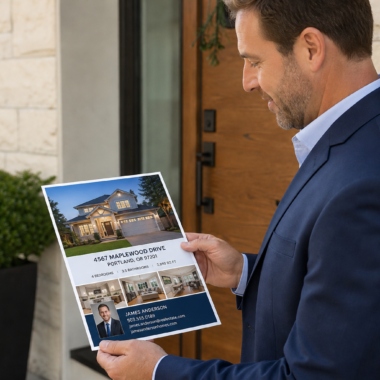

The best size for real estate flyers depends on how and where you use them. For most listings, 8.5 × 11 inches balances impact, detail, and portability. Half-letter and rack cards excel for handouts and displays. At 5004 Timberlea Blvd Unit#18 in Mississauga, Top Realtor Sign & Print can prep the best size for real estate flyers with same-day pickup.
By Ashwani — Top Realtor Sign & Print · Last updated: May 4, 2026
What’s the Best Size for Real Estate Flyers? (Quick Summary)
Start with 8.5 × 11 inches for property flyers. It holds a hero photo, 3–4 interior shots, a features grid, map, QR code, and disclaimers without crowding. For volume handouts, choose 5.5 × 8.5; for brochure racks, go 4 × 9. Match flyer dimensions to placement, reading distance, and message density.
Here’s the thing: buyers see your materials at different moments—curbside, in the lobby, at the kitchen island. One size can’t win every moment. Use a core size for depth (letter) and mix smaller formats for reach (half-letter, rack cards, postcards) so your message always fits the moment.
- Core pick: 8.5 × 11 (letter) for complete listing stories
- High-volume handouts: 5.5 × 8.5 (half-letter)
- Brochure racks & lobbies: 4 × 9 (rack card)
- Neighborhood mailers: 6 × 11 or 6.5 × 9 postcards
- Open house displays: 11 × 17 (tabloid), folded to booklet
- Yard-sign takeaways: 5 × 7 or 4 × 6 cards with a QR code
Quick Comparison Table
Choose flyer size by channel. Letter (8.5 × 11) leads for in-depth property details, half-letter (5.5 × 8.5) is ideal for event stacks, rack cards (4 × 9) shine in holders, large postcards (6 × 11 or 6.5 × 9) win mailboxes, and tabloid (11 × 17) anchors in-home displays.
| Size (in) | Alias | Best Use | Where It Lives | Why It Works |
|---|---|---|---|---|
| 8.5 × 11 | Letter | Main listing flyer | Sleeves, packets | Room for photos, specs, map, QR |
| 5.5 × 8.5 | Half-letter | High-volume handouts | Stacks, door-to-door | Efficient 2-up from letter sheets |
| 4 × 9 | Rack card | Brochure racks | Holders, lobbies | Tall, visible, upright format |
| 6 × 11 | Large postcard | Neighborhood mail | Mailbox stacks | Bold, flat-friendly visibility |
| 6.5 × 9 | Jumbo postcard | Farming mailers | Mailbox stacks | Extra canvas for bullets/photos |
| 11 × 17 | Tabloid | Open house display | Easels, tables | Folds into a mini brochure |
| 5 × 7 | Invitation | QR takeaways | Near yard signs | Pocket-friendly reminders |
| 4 × 6 | Small postcard | Leave-behinds | Cafes, offices | Fast to print and carry |
| 8.5 × 14 | Legal | Spec-heavy flyers | Clipboards, packets | 27% more vertical space |
| 9 × 12 | Sell sheet | Luxury listings | Folders, packets | Premium, gallery-style feel |
| A5 (5.8 × 8.3) | ISO A5 | Minimal layouts | Euro racks | Compact and refined |
| 8 × 10 | Photo size | Single-image layouts | Frames, displays | Strong for hero imagery |
Pro move: keep a consistent headline style across sizes so buyers immediately connect the dots from the mailbox to the foyer table to the brochure rack. That brand echo is what turns curiosity into a showing request.

Our Top Pick: 8.5 × 11 for Most Listings
8.5 × 11 is the best all-around size for real estate flyers because it balances storytelling space and portability. It supports big photography, clear feature bullets, neighborhood maps, lender notes, and a QR code on a single sheet—easy to sleeve, stack, and reprint on demand.
In our experience, letter-size flyers anchor the listing packet. We consistently see agents combine: a full-bleed hero image at the top, three supporting photos, a specs grid, and a scannable QR code that routes to the virtual tour. That layout holds up across condos, semis, and detached homes.
- Why it works: Ample canvas for visuals and data without forcing 7-point type.
- Where it shines: Open houses, showings, listing packets, and sign brochure boxes.
- Production win: Fast press setup and easy same-day replenishment.
Want ready-to-print templates sized perfectly for letter? Browse our flyer printing options and upload art, or use our online editor to swap photos and QR codes in minutes.
Best Sizes Ranked (#2–#12)
After letter, pick 5.5 × 8.5 for event stacks and door-to-door, 4 × 9 for brochure holders, and 6 × 11 for attention-grabbing mail. Round out with 11 × 17 for displays and 5 × 7 or 4 × 6 as quick takeaways. Match size to distance and distribution.
#2 — 5.5 × 8.5 (Half-Letter)
- Use when: You need thousands of handouts for busy open houses or community days.
- Why: It’s printed two-up from letter sheets, trimming fast while staying sturdy.
- Design tip: Keep copy to 60–100 words with one hero photo; use a compact QR.
- Pairs with: Counter stacks and custom sign riders that mirror your headline.
#3 — 4 × 9 (Rack Card)
- Use when: You need upright visibility in holders at brokerages, lobbies, and cafes.
- Why: The tall profile resists slumping in racks and stays front-facing.
- Design tip: Run a vertical image, bold headline, and bottom QR for scanning.
- Complement with: Matching luxury business cards so your leave-behinds feel cohesive.
#4 — 6 × 11 (Large Postcard)
- Use when: You’re farming a neighborhood and want mailbox-dominant presence.
- Why: The width and height stand out in mail stacks without being unwieldy.
- Design tip: Front = hero photo + headline; back = features, map, CTA, and QR.
- Helpful reference: See our standard postcard measurements overview.
#5 — 6.5 × 9 (Jumbo Postcard)
- Use when: You need more breathing room than 6 × 11 for bullets and photos.
- Why: The proportions favor two-column layouts with comfortable margins.
- Design tip: Keep safe areas clear for addressing and barcodes when mailing.
- Order option: Review sizes in our postcards category.
#6 — 11 × 17 (Tabloid)
- Use when: You want a display sheet that also folds to create a mini brochure.
- Why: Perfect for floorplans, amenity maps, and a two-spread photo story.
- Design tip: Plan for fold gutters and panel widths; test the fold at 100% scale.
- Stage with: A roll-up banner that echoes the same headline and colors.
#7 — 5 × 7
- Use when: You need pocket-friendly cards near a yard sign or front table.
- Why: Big enough for a hero image and 5–7 bullets; easy to slip into a pocket.
- Design tip: Size QR codes at least 0.8 inches; test scans from 2–3 feet.
- Pair with: Coordinated Realtor packages for unified branding.
#8 — 4 × 6
- Use when: You’re distributing quick takeaways at cafes, gyms, or coworking spaces.
- Why: Extremely efficient to print, carry, and replenish during a campaign.
- Design tip: One strong image, a punchy headline, single CTA, and QR.
- Keep learning: Track sizes via our postcard sizes tag.
#9 — 8.5 × 14 (Legal)
- Use when: Floorplans, multiple models, or spec-heavy content need extra room.
- Why: Adds about a quarter more vertical space than letter without new holders.
- Design tip: Keep primary content in the top 10.5 inches for quick scanning.
- Good with: Presentation folders for premium packets.
#10 — 9 × 12 (Sell Sheet)
- Use when: You want a gallery feel for high-end properties or builder releases.
- Why: Wider margins make photography pop and signal quality.
- Design tip: Consider soft-touch or raised UV finishes for tactile impact.
- Upgrade path: Explore premium business cards to match.
#11 — A5 (5.8 × 8.3)
- Use when: Minimalist designs or international audiences are in play.
- Why: Compact and refined; familiar outside North America.
- Design tip: Convert mm to inches carefully for bleed and safe zones.
- Note: Check holder compatibility if mixing with letter-based materials.
#12 — 8 × 10 (Photo)
- Use when: You’re framing displays or creating gallery-style layouts.
- Why: Photo-forward format that spotlights a single hero image.
- Design tip: Keep symmetrical margins that echo photo prints.
- Display with: An easel or acrylic stand for entry tables.
Need it today? Our Mississauga team offers same-day pickup on popular flyer sizes and rush options for listings and open houses. We’ll align your design to brokerage brand guides—fast—so you can focus on showings.
How to Choose the Right Flyer Size
Match size to distance, density, and distribution. Use letter for deep storytelling at arm’s length, half-letter for stacks and door-to-door, rack cards for holders, and large postcards for mail. Consider bleed, trim, QR minimums, and image resolution before you export print-ready PDFs.
- Define the placement: On-site packets, door-to-door, racks, mail, or displays?
- Estimate reading distance: At 12–24 inches, body type should sit around 9.5–11.5 pt; headlines 18–32 pt.
- Right-size the message: If copy exceeds 140–160 words, size up or move details to the back.
- Plan finishing: Folds, drill holes, and saddle-stitching reduce usable space.
- Check specs: Add 0.125-inch bleed; export CMYK at 300 dpi; verify overprint/knockout.
Local considerations for 5004 Timberlea Blvd Unit#18
- Time open-house flyers for weekend tours. Same-day pickup lets you pivot after Friday showings near Canadore College at Stanford Mississauga Campus.
- Winter light in the Regional Municipality of Peel can dull prints; favor high-contrast photos and matte finishes to reduce glare at late-afternoon showings.
- For commuter outreach near Tomken Station East Platform A, stock 4 × 9 rack cards with QR codes that link to your listing page for quick scans.
Design & Print Specs Checklist (Buying Guide)
Export print-ready PDFs with a 0.125-inch bleed, 300 dpi images, and CMYK color. Keep live elements 0.125–0.25 inches from trim, size QR codes ≥ 0.8 inches, and proof both sides at 100%. Consistent margins and clear hierarchy boost legibility and retention.
- Bleed & trim: Add 0.125-inch bleed on all sides; keep live content away from the knife.
- Resolution: Use 300 dpi at final size. Avoid stretching screenshots or low-res MLS images.
- Color space: Export CMYK or use a print-optimized PDF/X preset.
- Typography: Headlines 18–32 pt; body 9.5–11.5 pt; 1.2–1.45 line height.
- QR codes: Minimum about 0.8 inches square; test from 2–3 feet under indoor light.
- Finishes: Gloss for punchy photos; matte or soft touch for luxury feel.
- Folds & panels: For 11 × 17, plan panel widths and gutters precisely.
- Preflight: Embed images, outline fonts as needed, and review overprint/knockout.
To streamline approvals and handoffs, many teams use a creative brief. A concise brief clarifies the audience, the listing’s hook, and must-have visuals before design starts. Consider using a structured worksheet like this creative brief template library to align your team quickly.

Tools & Resources for Realtors
Use properly sized templates, a browser-based editor, and coordinated materials. In our 5004 Timberlea Blvd Unit#18 neighborhood in the Regional Municipality of Peel, same-day pickup helps agents tighten timelines while keeping flyers, postcards, and banners visually consistent from curb to closing.
- Grab ready-made templates sized for 8.5 × 11, 5.5 × 8.5, and 4 × 9 to reduce revisions.
- Keep branding synced with flyers, yard signs, open house signs, and roll-up banners.
- Build listing packets with matching brochures, presentation folders and kits.
- Use an online editor to swap photos and live QR codes without desktop design software.
- For mailing campaigns, review postcard standards in our postcard measurements guide.
- Explore general print setup tips in this poster printing resource for resolution and file prep reminders.
- For campaign planning, see these postcard selling insights to help structure content and calls to action.
Mini Case Studies
Mixing sizes multiplies touchpoints. We see stronger inquiries when agents pair a letter flyer at showings with rack cards in lobbies and large postcards in the neighborhood. Buyers encounter a consistent message in multiple contexts, which nudges them to book a viewing.
- Open house surge: A GTA agent used 11 × 17 folded displays on easels plus half-letter handouts. Visitors referenced the large spread while pocketing the takeaways—faster table flow and better conversations.
- Condo launch: 4 × 9 rack cards saturated nearby cafes while 8.5 × 11 sheets lived in the lobby. A shared headline and QR code made attribution simple.
- Neighborhood farming: Large postcards combined with 5 × 7 takeaways near the yard sign helped weekend walkers save the listing on their phones.
We also recommend tying your print to brand assets—color, typography, and photography style. When your rack cards echo your business cards, you build recall faster and look organized under pressure.
Frequently Asked Questions
Most agents ask two things: which size fits their channel, and how to avoid reprints. Use 8.5 × 11 unless racks or mail dictate another size, and export 300 dpi, CMYK PDFs with bleed and safe margins for crisp, edge-to-edge results.
What is the best size for real estate flyers at an open house?
Use 8.5 × 11 for the main property flyer and 11 × 17 as a folded display sheet on an easel. If you expect heavy foot traffic, add 5.5 × 8.5 takeaways so guests can grab one quickly without crowding the table.
Which flyer size works best for brochure racks?
Choose 4 × 9 rack cards. The tall, narrow format stands upright in common literature holders and stays visible. Use a bold headline, one vertical image, and a bottom QR code for easy scanning.
What print specs prevent blurry or cut-off flyers?
Export print-ready PDFs at 300 dpi with a 0.125-inch bleed and CMYK color. Keep live text and logos 0.125–0.25 inches from trim, and size QR codes at least about 0.8 inches square. Always proof at 100% scale.
Are A-series (A4/A5) sizes acceptable in North America?
Yes, but letter-based sizes are more common. A5 (5.8 × 8.3) can look refined for minimal layouts. Confirm compatibility with holders and frames if you’re pairing them with letter-size materials.
Methodology
We ranked sizes by visibility, holder/mail fit, production speed, and capacity for details. We favored dimensions that print efficiently, read well at arm’s length, scan reliably with QR codes, and slot into real placements—from sleeve boxes and racks to mail stacks and easels.
- Readability tests at roughly 12–24 inches for body text; 3–6 feet for headlines in displays.
- Mapping to placements: sleeve boxes, racks, mail, lobbies, and open house tables.
- Production checks for fast turnarounds and same-day pickup on popular sizes.
- Brand continuity across signs, rack cards, flyers, folders, and brochures/flyers.
Conclusion
Make 8.5 × 11 your core real estate flyer, then add 5.5 × 8.5 for volume and 4 × 9 for racks. Use 6 × 11 for mail and 11 × 17 for displays. Sizing to channel and distance maximizes visibility, compresses timelines, and keeps your brand consistent across touchpoints.
Key Takeaways
- Letter (8.5 × 11) carries the full listing story without tiny type.
- Half-letter and rack cards increase reach in stacks and holders.
- Large postcards dominate mailboxes; tabloid anchors displays.
- Use 300 dpi, CMYK, and 0.125-inch bleed to avoid reprints.
- Echo headlines and colors across signs, flyers, and folders.
Ready to print? Stop by our Mississauga shop for fast, brand-aligned flyers sized for your channel—pickup available the same day on popular options. We’ll help you pick the right size, finishes, and folding to match the plan.