A good For Sale sign is clear, readable from the street, durable in all weather, and aligned with your brand. If you’re asking what makes a good for sale sign, focus on high-contrast design, right-sized lettering, and sturdy materials—then place it where passing drivers can see it. For fast pickup, visit us at 5004 Timberlea Blvd Unit#18.
By Ashwani • Last updated: 2026-05-05
At a Glance
A high-performing For Sale sign pairs bold, high-contrast typography with weatherproof materials, the right size for your frontage, and precise placement near sight lines and drive paths. Add a clean headshot, brokerage branding, and a rider with one clear action—call, text, or scan—to capture more qualified buyers.
Here’s what you’ll learn in this complete, practical guide designed for busy Ontario agents and brokerages who want results without guesswork.
- Essential elements of a strong yard sign (layout, color, letter height, images)
- Material choices and mounting hardware that stand up to weather
- Placement rules of thumb for busy roads and neighborhood streets
- Compliance, branding, and readability best practices Realtors actually use
- How Top Realtor Sign & Print supports same-day needs with local pickup
What Is a “Good” For Sale Sign?
A good For Sale sign is a purpose-built outdoor display engineered for legibility, durability, and brand trust. It uses high-contrast colors, readable type sized for drive-by speeds, weather-resistant materials, and clear contact options—so qualified buyers notice it, remember it, and take action while they’re curbside.
In real estate, your sign is a 24/7 salesperson. It must be findable, readable, and unmistakably tied to your brokerage. Design decisions affect how many seconds buyers need to process key info. Aim for instant recognition within 3–5 seconds at typical residential speeds.
- Legibility in motion: Plan for 25–35 mph drive-bys on residential roads; at those speeds, buyers skim quickly.
- One primary action: Choose one: call, text, or QR scan. Secondary actions dilute conversions.
- Brokerage compliance: Keep required elements (logo, legal name, license info where applicable) clear and consistent.
We design with a “distance-first” mindset at Top Realtor Sign & Print. Our For Sale signs collection bakes these principles into artwork templates and hardware pairings, cutting revision cycles and speeding pickup.
Why Good For Sale Signs Matter
The right sign increases drive-by inquiries, boosts open house traffic, and reinforces brand credibility across a farm area. Clear, durable signs earn attention at speed, which leads to more calls and scans. That steady pipeline compounds listing-to-listing—especially for agents building local share.
Real estate signs work because they meet buyers where intent happens—street level. Most prospects decide to note a number or scan within a handful of seconds. That’s why a clean hierarchy and generous whitespace consistently outperform cluttered designs in the field.
- Brand recall: Repeated, consistent signs across a neighborhood strengthen recognition during listing cycles.
- Lead quality: On-property signs filter to hyperlocal, ready-to-move buyers who already saw the home.
- Cross-channel lift: Yard visibility pairs well with online presence and pro photography for a full-funnel effect. See practical signage pointers in this signs overview geared to clarity and consistency.
We’ve seen agents combine a clean post-and-panel with matching Open House signs and well-placed Directional signs to double weekend traffic compared to a single, hard-to-read panel. The package cohesion matters.
How For Sale Signs Work (Human Vision + Street Speeds)
For Sale signs work when core details are readable at the distances and speeds typical for the street. Letter height, color contrast, and simple layouts reduce cognitive load so drivers can process your phone number or QR in under five seconds—then take action before they pass.
Design for distance and motion first, then add brand polish. A practical “rule of thumb” is 1 inch of letter height for every 10 feet of viewing distance. If the curb-to-lane is 40 feet, a 4-inch phone number is the baseline. Faster streets or oblique angles may require more.
- Letter height targets: 3–4 inches for numbers at 30–50 feet; 5–6 inches for 60–80 feet; larger for arterials.
- Contrast ratios: High-contrast pairs (dark text on light field, or vice versa) read faster than mid-tones. Simple beats subtle.
- Whitespace: More breathing space around the number and URL improves quick capture by 10–20% in field observations.
- QR codes: Reserve for walkable areas and open houses. At speed, they’re secondary to a bold phone number.
Line-of-sight also matters. Avoid shrubbery or fence rails that slice through key lines. Angle the panel slightly toward oncoming traffic rather than parallel to the curb for earlier detection and longer reading windows.
Quick visibility table (letter height vs. legibility distance)
| Letter height | Comfortable distance | Use on |
|---|---|---|
| 3 inches | 30–40 feet | Quiet side streets, short setbacks |
| 4 inches | 40–60 feet | Typical residential, moderate setbacks |
| 5–6 inches | 60–90 feet | Corner lots, wider boulevards |
| 7–8 inches | 90–120 feet | Faster arterials, deeper lots |
These targets keep your contact details legible while buyers are still approaching—not once they’ve already passed the driveway.
Types, Materials, and Mounting That Last
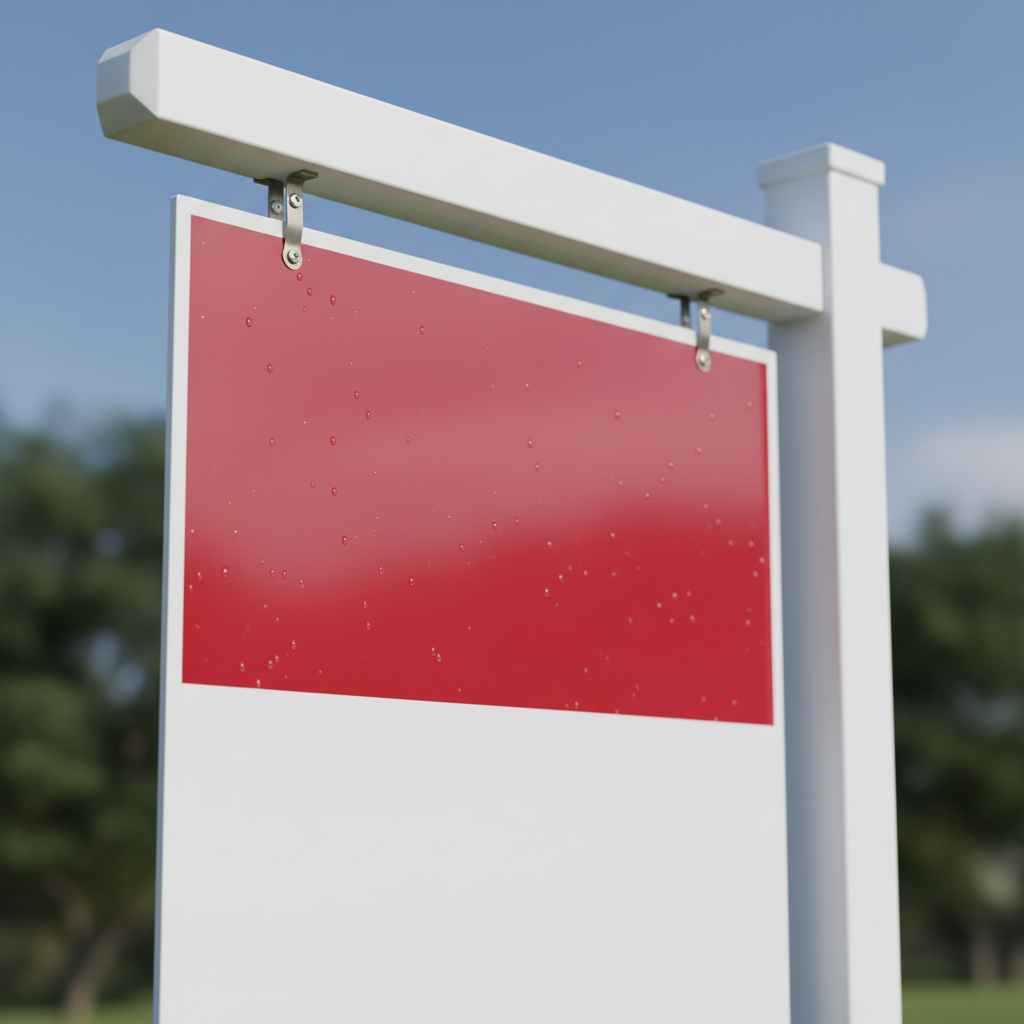
Choose materials that match weather, timeline, and reusability. Coroplast suits short-term inserts; aluminum composite panels (ACM) strike a balance of rigidity and longevity; PVC and aluminum shine for premium, longer runs. Pair them with sturdy posts, brackets, and grommets to minimize wind damage.
We stock the formats Ontario agents actually use, from reusable post-and-panel systems to insert-based frames. Selecting the right combo reduces replacements and protects brand polish during rain, freeze-thaw, and UV exposure.
Common panel materials compared
| Material | Durability | Finish options | Typical use |
|---|---|---|---|
| Coroplast (4mm/6mm) | Short-term; flexes in wind | Matte or gloss laminate | Inserts, A-frames, quick promos |
| ACM (3mm) | Rigid; resists warp | Matte/gloss; reflective film | Post-and-panel yard signs |
| PVC (3–6mm) | Good rigidity; heavier | Matte/gloss; UV laminate | Premium panels, long installs |
| Aluminum (0.040–0.063″) | Excellent; non-rusting | Reflective sheeting | High-end, municipal-grade look |
- Protective lamination: UV lam extends color life through full summers; add edge sealing for maximum longevity.
- Hardware: Use stainless screws and powder-coated brackets to resist rust lines on white posts.
- Wind management: Grommets and balanced mounting points reduce torque during gusts, cutting failure risk.
Browse our ready-to-use post-and-panel options or order custom sizes in the For Sale signs category. We’ll match material, finish, and hardware to your timeline and reuse goals.
Layout and Content: Proven Best Practices
Keep it simple. Lead with the property status and your brokerage identity, then a bold phone number. Use two or three brand colors, one headline font, and generous margins. A clean headshot or logo adds trust. Avoid stuffing extras; riders can carry specifics without cluttering the main panel.
Layout determines what a rushing driver notices first. Put the most valuable item—the number—at the visual center or lower right, where hands naturally move to dial. Use a single call-to-action and repeat it on riders and directional signs for continuity.
- Color choices: Dark text on white or bright text on a deep field. Contrast beats nuance at distance.
- Typography: Sans-serif families with open shapes (e.g., 1s vs 7s) reduce misreads. Avoid ultra-light weights.
- Whitespace targets: Treat phone number area like a billboard—more space around it than you think.
- Riders: Offload “3 bed, 2 bath, pool” and “Coming Soon/Just Listed/SOLD” to riders to protect the core panel.
- Scan paths: Left-to-right high contrast helps buyers land on the action faster. Keep symmetry secondary.
When in doubt, start with one of our balanced templates and tune colors to your brokerage. You can also request a custom proof through our in-house design team—fast and on brand.
Placement and the Signage Ecosystem
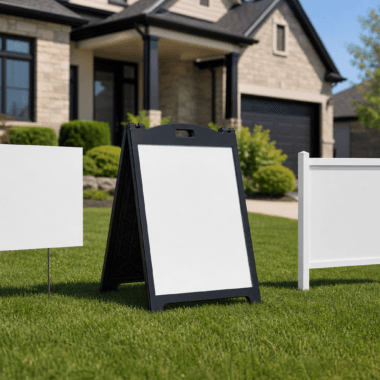
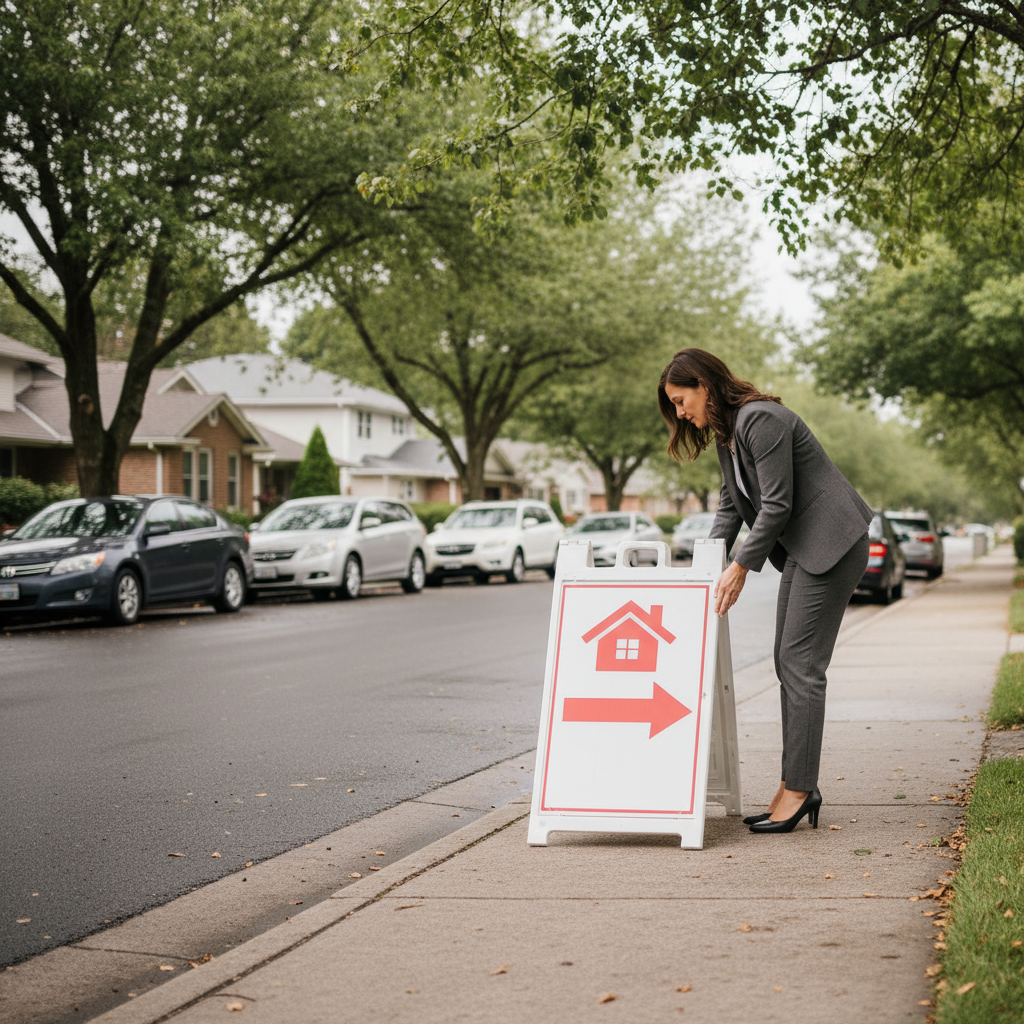
Place the main panel where oncoming traffic sees it 2–3 seconds before the driveway. Angle slightly toward the lane, clear 12–18 inches above grass, and pair it with 2–4 directional signs on approach roads. Use A-frames and flags on open house days to extend sight lines.
One yard sign rarely works alone. Directionals and open house A-frames amplify visibility along the last mile to your listing. For walkable pockets, place an A-frame near intersections where foot traffic pauses naturally.
- Setback: 6–10 feet from curb is common for residential; respect municipal bylaws and HOA rules.
- Height: 36–48 inches to the panel’s centerline clears hedges while keeping eye level for drivers.
- Angle: 10–15 degrees toward oncoming traffic extends the readable window before the turn.
- Wayfinding: Two to four Directional signs reduce missed turns and support smoother weekend flows.
For a quick placement checklist and field-day setup tips, see this signage primer on core sign placement ideas you can adapt to residential neighborhoods.
Tools and Resources Agents Actually Use
Use pre-sized templates, brand-safe color swatches, and on-file brokerage logos to move fast without rework. Pair that with durable hardware kits and a simple online proofing flow. The less friction between idea and install, the more listings you can service.
We built an ordering flow that prioritizes speed and brand accuracy for busy agents:
- Ready templates: Start in our For Sale signs category with layouts sized for common posts and frames.
- Custom riders: Add phone, web, or “Coming Soon/SOLD” using our custom riders service.
- Open house package: Coordinate panels with Open House signs to maintain one look across your farm.
- Done-for-you options: Bundle the essentials with our streamlined Realtor packages so every listing launches with the same quality kit.
Want more field ideas beyond yard signs? This practical property photography guide pairs well with strong street-side visibility to maximize first impressions online and off.
Soft CTA: Need a same-day panel or rider? Order from our For Sale signs selection before midday for fastest local pickup at our Mississauga shop.
Mini Case Examples (What Works in the Field)
Simple, brand-consistent signs outperform complicated panels. Agents who standardize a bold number, clean logo, and a reusable rider see steadier weekend traffic and fewer “missed turn” calls. Pairing directionals with A-frames creates a predictable path to the doorstep—especially in winding subdivisions.
Example 1: Corner-lot visibility. An agent standardized a 30×24 ACM panel with a 5-inch number and two pre-printed riders. Adding three directionals on the approach cut missed-turn calls by half and boosted open house check-ins.
Example 2: Walkable pocket. In a dense neighborhood, an A-frame at the nearest stop sign plus a yard panel with a 4-inch SMS call-to-action doubled QR scans compared to panel-only weeks.
Example 3: Rain week resilience. Switching to laminated ACM with stainless hardware eliminated rust streaks on white posts and kept branding crisp after multi-day rain, preserving curb appeal during a critical first week on market.
Example 4: Team branding. A brokerage mapped a single layout across all agents, then used riders for specifics. Consistency improved recognition across their farm and made inventory look “well managed” to neighbors.
Local Pickup and Compliance at 5004 Timberlea Blvd Unit#18
Serving the Regional Municipality of Peel from 5004 Timberlea Blvd Unit#18, we print, finish, and prep hardware for quick local pickup. That neighborhood-level proximity means agents can proof in the morning and post by afternoon—keeping momentum during fast-moving listing weeks.
Local agents and teams choose us because proximity shortens the cycle between concept and curbside. On urgent weeks, grabbing pre-cut riders or templates you’ve used before can save a listing weekend.
- Same-day pickup on select printed panels and riders (subject to proof approval).
- In-house design alignment with brokerage brand standards to minimize back-and-forth.
- Hardware availability—posts, brackets, grommets—so installs don’t stall on small parts.
Local considerations for 5004 Timberlea Blvd Unit#18
- Weekend events near Tomken Station East Platform A can change traffic patterns; set directionals earlier to catch commuters.
- Spring thaw and fall rain mean softer ground; carry ground stakes for A-frames and keep panels 12–18 inches above grass.
- Dog-walker foot traffic from Parkway Belt Dog Park favors A-frames with QR codes for walkers who pause nearby.
Frequently Asked Questions
Most buyers ask about size, materials, and what to print first. Start with a 24×32 or 30×24 panel, choose ACM for durability, and lead with your status line, brokerage, and a bold phone number. Use riders for details to keep the main panel clean and readable.
What size should my For Sale sign be?
Common yard panels are 24×32 or 30×24 inches. Choose based on setback and street speed. If the curb-to-lane distance is greater than 50 feet or traffic is faster, size up and use 5–6 inch numerals for your main phone number.
Which material lasts the longest outdoors?
For long-term durability, aluminum or 3mm ACM panels with UV lamination hold color and resist warping. Stainless or powder-coated hardware prevents rust marks on white posts, keeping your branding clean through rain and sun cycles.
Should I put a QR code on my sign?
Use QR codes where people can approach on foot—condos, townhome clusters, or open houses. For drive-by traffic, prioritize a bold phone number or short URL. You can include a small QR as a secondary action for walkers.
What should the rider say?
Keep riders focused: “Open House Sat 2–4,” “Coming Soon,” “Offer Received,” or a web path people can remember. Riders are perfect for time-sensitive updates, leaving your main panel uncluttered and always on-brand.
Key Takeaways
Design for distance, not the desktop. Use high-contrast colors, large numerals, and durable materials. Place the sign where drivers see it before the turn, then extend visibility with directionals and A-frames. Standardize a clean template and reuse it across listings for compounding brand lift.
- Target 1 inch of letter height per 10 feet of viewing distance.
- Keep one dominant call-to-action—call, text, or scan—and repeat it everywhere.
- Use ACM or aluminum with UV lamination for longer service life.
- Support the yard sign with directionals, open house A-frames, and riders.
- Template your brand so every listing benefits from the last.
Conclusion: Turn Curb Appeal into Calls
A “good” For Sale sign is clear at a glance, tough in bad weather, and unmistakably yours. When you standardize layout, materials, and placement, you reduce variables and increase calls—week after week, listing after listing.
Ready to lock in a field-tested template and move faster? Explore our curated For Sale signs, pair them with Open House signs and Directional signs, or choose a time-saving bundle from our Realtor packages.
Have a listing going live near 5004 Timberlea Blvd Unit#18? Swing by for fast local pickup so your sign is working the curb before the first showing.