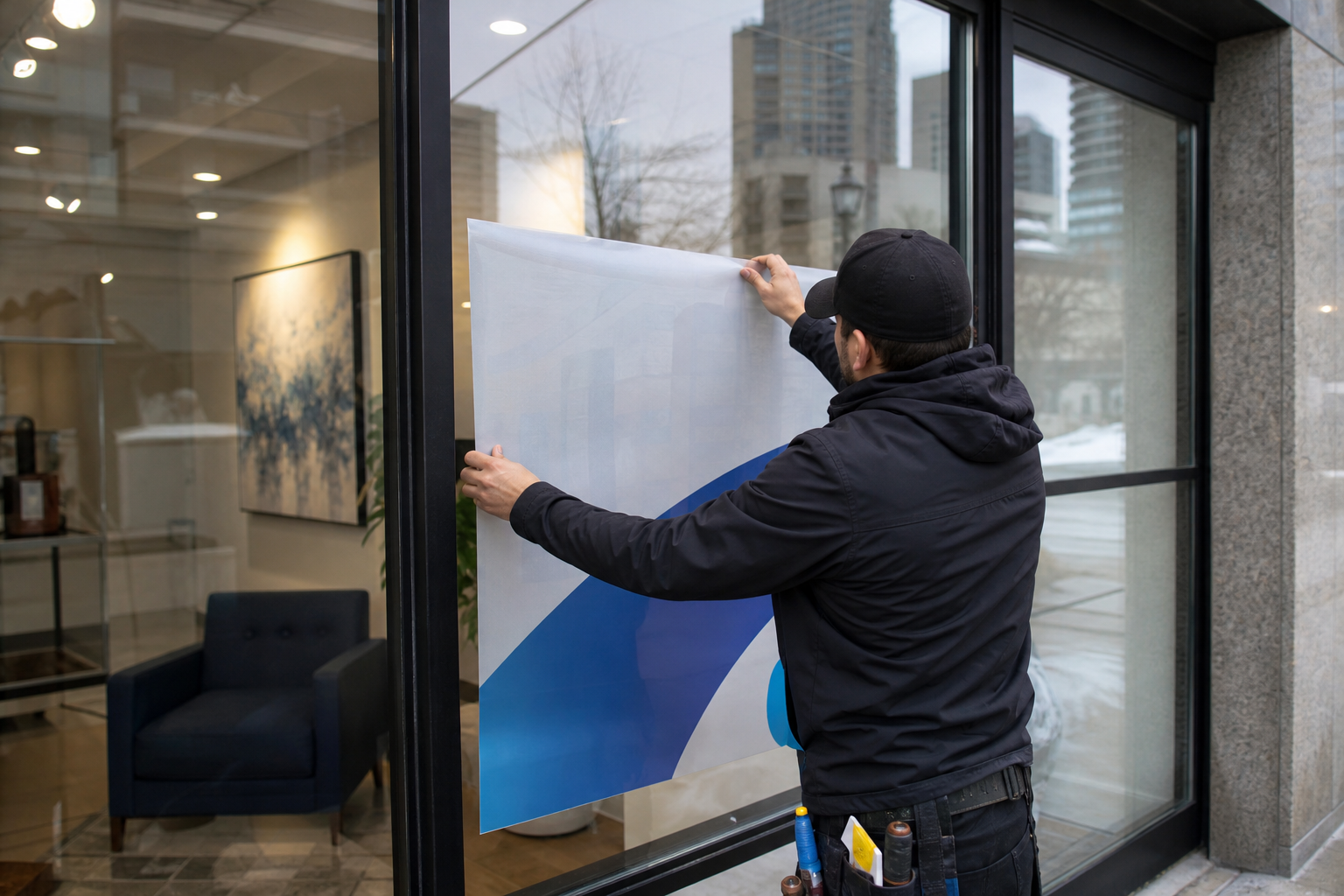
Window clings can be a practical choice when you need temporary or changeable graphics on glass without committing to permanent adhesive signage. They may suit a storefront promotion, office partition, real estate listing, event message, or seasonal campaign, but the right option depends on the glass, viewing direction, design, installation conditions, and how long you need the graphic in place.
This guide explains what window clings are, how they differ from decals and posters, which design approach may fit your goal, and what to confirm before ordering in Mississauga. It is also important to check local sign requirements and confirm the material, removal characteristics, and production details with your chosen printer.
What Are Window Clings?
Window clings are graphics designed to adhere to glass without relying on a permanent adhesive bond. In everyday buying language, you may also see terms such as window graphics, window decals, storefront window decals, removable window signs, or static window clings.
These terms are not always used consistently. A “window decal” may refer to a removable cling in one supplier’s catalogue and an adhesive vinyl graphic in another. Before ordering, ask the printer to identify the material, intended surface, viewing direction, removal method, and whether the product is designed for reuse.
In Mississauga, the formal municipal term is “window sign.” The City describes this as a sign posted, painted, placed, or affixed in or on a publicly visible window, so a temporary product can still fall within local sign rules. Review the City’s sign by-law information before finalizing a public-facing installation.
Choose the Right Window Cling Design

The most important design decision is how much of the glass should remain visible, where the message must be readable, and whether people need to see through the graphic from one or both sides.
Transparent or clear designs
A transparent approach can preserve more of the glass’s visual openness and may work when daylight, interior visibility, or a lighter branded appearance matters. Ask how colours and fine text will appear against the glass and the background behind it.
Opaque designs
Opaque graphics generally provide a stronger visual block behind the printed message. This can help bold branding, promotional copy, or directional information stand out, but it can also reduce visibility through the covered area.
Privacy and partial-coverage graphics
Privacy-oriented graphics may suit meeting-room glass, office partitions, lower storefront sections, or areas where people need visual separation without covering the entire window. Confirm whether the graphic should obscure views from outside, inside, or both.
Which Window Cling Format Fits Your Use Case?
| Use case | Likely priority | Question to confirm |
|---|---|---|
| Storefront promotion | Strong contrast, short copy, and clear calls to action | Will the message remain readable from normal viewing distance? |
| Real estate listing or open house | Brand visibility, listing information, and easy campaign changes | Should the graphic be visible from outside, inside, or both? |
| Office or meeting-room glass | Privacy, wayfinding, or understated branding | How much visibility must remain? |
| Event or seasonal campaign | Temporary installation and a defined removal date | Is the material intended for one use, storage, or reuse? |
| Local business branding | Consistent colours, logo placement, and visual identity | Will lighting and the glass background alter contrast? |
Window Clings Compared With Other Marketing Formats
Window clings are not automatically the best answer for every campaign. They use existing glass, so they can suit a specific storefront, office, or property, but they may be less suitable when the audience is moving past at a distance or no appropriate window is available.
Window clings vs. adhesive decals
The central difference is surface commitment. A removable cling suits messages that may change or glass that must return to its original appearance. An adhesive decal may be more appropriate for a longer-lasting installation. Ask about the specific glass, coatings, installation period, temperature, and removal process.
Window clings vs. posters and flyers
A poster may be simpler when the message needs frequent replacement or the window is unsuitable for direct application. A cling can provide a more integrated glass-mounted presentation, but it requires more attention to measurements, installation, and removal. Same-day availability for another printed item should not be assumed to apply to window graphics.
Window clings vs. real estate signs and roll-up banners
For sale signs, open house signs, and directional signs can communicate beyond the immediate window. Roll-up banners can create a freestanding display where there is no suitable glass. For broader display planning, compare common large-format printing uses before choosing a format.
Window clings vs. neighbourhood outreach
A window graphic reaches people who encounter a particular storefront, office, or property. For a wider local campaign, consider pairing the glass message with promotional door hangers or another neighbourhood format that can target specific streets or zones.
Prepare the Artwork and Measurements Before Ordering
Measure the visible area
Record the usable width and height of each window, not just the overall frame size. Note mullions, handles, locks, vents, frames, counters, shelves, existing signs, and required edge clearances. Measure each pane separately when dimensions differ.
Plan for viewing direction and contrast
Tell the printer whether the artwork must be readable from outside, inside, or both. Some designs may need mirrored artwork or a layout that accounts for the glass background. Test the design at the approximate viewing distance rather than judging it only on a monitor.
Check the glass before installation
Assess dust, moisture, condensation, textured surfaces, existing films, coatings, scratches, and damage. These conditions can affect application, appearance, and removal. Ask which surfaces are suitable and whether the window requires specific preparation.
Installation, Removal, and Reuse Questions
Ask whether the graphic arrives ready to apply, whether professional installation is recommended, and what cleaning or preparation is required. Also establish how it should be lifted, whether residue is expected, how long it can remain in place, and how it should be stored if reuse is being considered. Reusability is product-specific, not an assumption based on the word “removable.”
Check Mississauga Window Sign Requirements
Publicly visible window graphics may be regulated even when temporary or removable. The City of Mississauga uses the term “window sign,” so describe your proposed installation accurately when asking about compliance.
The supplied municipal information reports a limit of 25% of a single window or window group for permitted window signs. Because the rule can depend on the property, window, sign type, and current by-law wording, verify it directly before production. Check the current sign by-law text and contact the City or property authority if the situation is unclear.
Window Cling Pre-Order Checklist
- Define the purpose, audience, location, campaign dates, and viewing direction.
- Measure every pane, including obstructions, frames, handles, and clearances.
- Choose a transparent, opaque, privacy-oriented, or partial-coverage approach.
- Confirm the material and whether it is intended for indoor, outdoor, or both settings.
- Check artwork, spelling, contact details, logos, and colours.
- Ask how the design will appear against the actual glass and background.
- Confirm surface preparation, installation, removal, residue, and storage.
- Verify quantity, timing, pickup or delivery, and approval requirements in writing.
- Check Mississauga rules before committing to the final size.
Questions to Ask the Printer
Ask: What does “window cling” mean for this order? Is it removable from my specific glass? Is it designed for inside or outside application? Will the artwork need to be mirrored? How will transparent areas and colours appear? What preparation is required? Who installs and removes it? Is reuse intended? What are the production and delivery timelines for this exact specification?
If ordering several products for a listing, event, or storefront campaign, confirm timing for each product separately. Signage, large-format printing, graphic design, and other marketing materials may not share the same material options or turnaround.
Frequently Asked Questions
Are window clings removable without damaging glass?
They are designed with removability in mind, but results depend on the material, glass condition, installation period, temperature, coatings, and removal method. Confirm the product-specific process.
What is the difference between a window cling and a window decal?
The terms vary by supplier. A cling usually refers to a graphic intended to attach without permanent adhesive, while a decal may use adhesive. Ask for the material, permanence, compatibility, and removal characteristics.
Should a storefront window cling be transparent or opaque?
Choose transparent when visibility or daylight matters, and opaque when stronger contrast is more important. Consider partial coverage if you need both branding and visibility.
Can window clings be used for real estate listings or open house promotion?
They can be considered when suitable glass is positioned for the intended audience. Confirm viewing direction, campaign duration, removal plans, and local sign requirements.
Do window clings require permission in Mississauga?
They may be subject to rules because publicly visible window graphics can be treated as window signs. Check the current City by-law and any property-specific requirements.
What measurements should I provide?
Provide the usable width and height of each pane, plus frames, mullions, handles, locks, shelves, and other obstructions. Include photos and identify application and viewing direction.
Conclusion: Decide Based on the Glass, Goal, and Timeline
Window clings suit changeable messaging on appropriate glass when measurements, artwork, installation, removal, and local requirements are planned carefully. Decals, posters, signs, banners, and neighbourhood print materials may be better for other audiences or locations.
For related real estate signs, large-format printing, graphic design, and marketing materials, discuss your project with Top Realtor Sign & Print and explain the exact glass application you are considering.