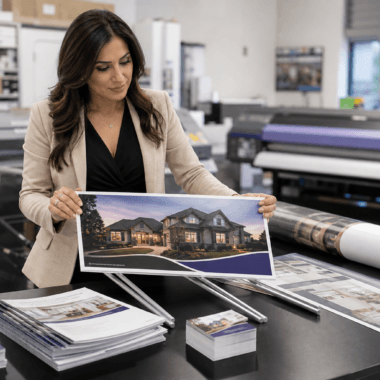
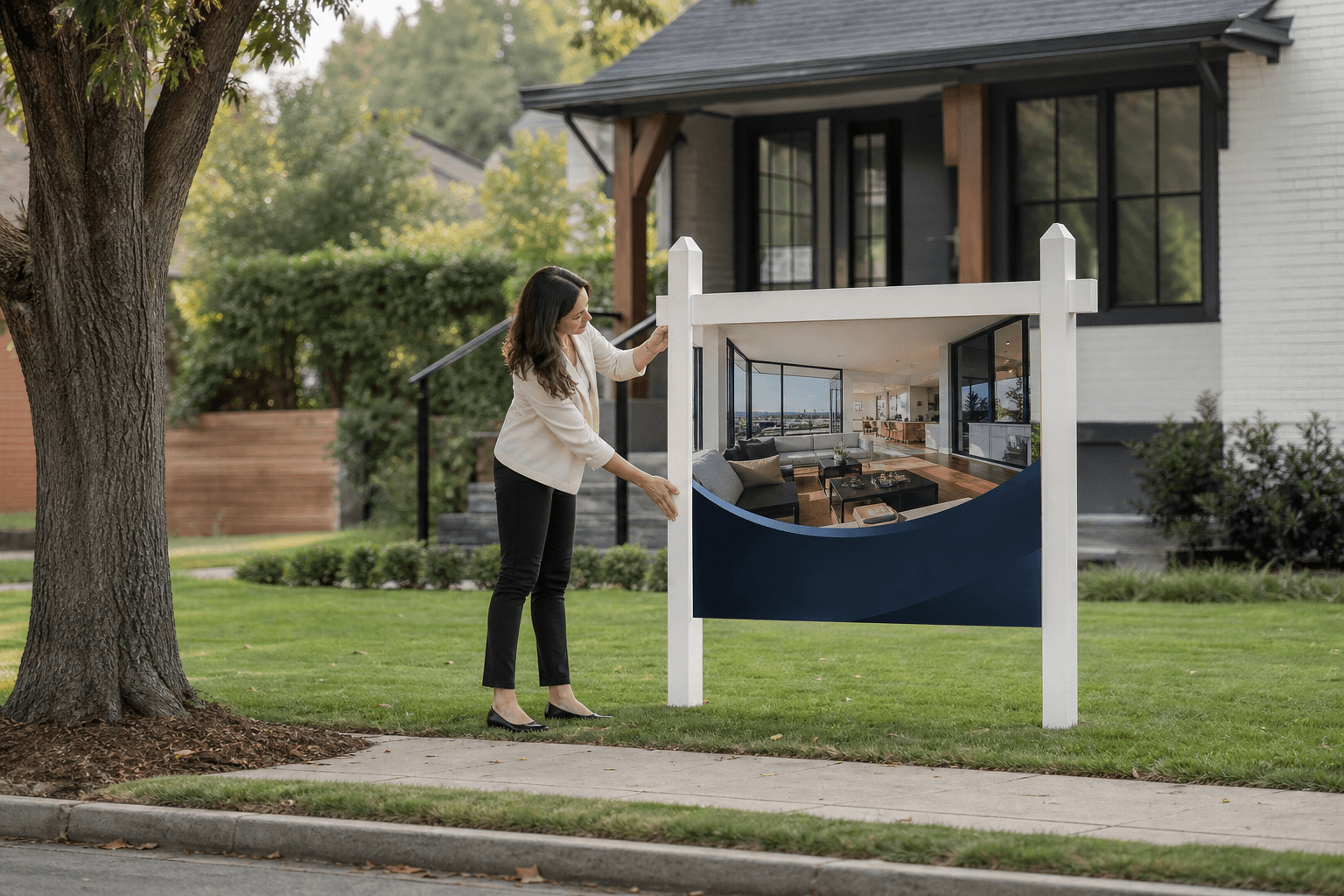
Large-format printing creates oversized printed materials designed to communicate across a broad physical area or remain readable from a distance. Common uses include real estate signs, directional signs, roll-up banners, event displays, and selected office or lobby graphics.
The best format depends less on size alone than on the viewing situation. Before ordering, consider where the display will be placed, how far away people will be when they see it, whether it will face weather or indoor conditions, how long it must remain in use, and what action the viewer should take.
Quick summary

- For Sale signs identify a property, while Open House and directional signs help visitors find it.
- Roll-up banners suit portable displays for offices, presentations, events, and lobbies.
- Outdoor projects require specific questions about weather, sunlight, finishing, mounting, and installation.
- Use short copy, strong contrast, readable scale, consistent branding, and one clear action.
- Confirm the exact product, artwork requirements, turnaround, pickup or delivery, and installation responsibility before approving the order.
What is large-format printing?
Large-format printing is the production of printed graphics that are substantially larger than everyday materials such as business cards, flyers, and brochures. The goal is usually visibility: the message needs to occupy a larger surface or remain legible when the viewer is standing across a room, walking through an event, or driving past a property.
You may also see the term “wide-format printing.” In everyday buying conversations, the two terms often describe overlapping work, including signs, banners, displays, and other oversized graphics. The important question is not which label a provider uses. It is whether the proposed product, material, finish, and size suit the environment where you will use it.
Large-format printing can be part of a broader marketing system. For a real estate agent, that might mean coordinating a For Sale sign with directional signs, riders, business cards, flyers, and a roll-up banner used at a presentation or open house.
Common large-format printing uses at a glance

The table below connects common applications with the setting and communication job they are intended to perform. Some applications are confirmed offerings from Top Realtor Sign & Print. Others are examples to discuss and confirm for your specific project.
| Application | Typical setting | Viewing situation | Primary purpose |
|---|---|---|---|
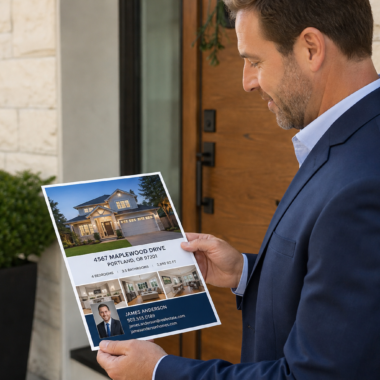
| For Sale signs | Residential or commercial property | Street-level and passing traffic | Identify the listing and provide contact information |
| Open House signs | Property entrances and nearby roads | Pedestrians and drivers approaching a turn | Announce an event and direct visitors |
| Directional signs | Intersections, paths, and access points | Short viewing time at decision points | Make the route or next step clear |
| Riders and inserts | Real estate sign systems | Close or moderate viewing distance | Communicate status, features, or a timely message |
| Roll-up banners | Offices, presentations, lobbies, and events | Indoor viewing across a room or queue | Present a brand, service, listing, or campaign |
| Other large graphics | Business, event, or display environments | Depends on placement and scale | Provide high-visibility information or branding |
For events, lobbies, and property marketing, large-format printing services can create highly visible displays that are easy to read from a distance. Ask the printer to confirm whether the particular graphic type you have in mind is available, especially for applications such as window, wall, floor, vehicle, or decal graphics.
Large-format printing uses for real estate marketing
For Sale signs identify the property
A For Sale sign has a simple job: help people recognize the listing and know how to find more information. The design normally needs a clear agent or brokerage identity, contact details, and enough contrast to remain readable from the relevant viewing distance. A QR code or web address can support a next step, but it should not compete with the main message.
Top Realtor Sign & Print lists customizable For Sale signs with high-resolution, full-colour printing, weather-resistant lamination, double-sided printing, UV-resistant and fade-resistant inks, and compatibility with standard real estate posts. Those features apply to that listed offering, not automatically to every large-format product, so confirm the specifications for your order.
Open House and directional signs guide visitors
Open House signs announce where an event is taking place. Directional signs perform a more specific task by helping a visitor make the next turn or follow a route. Because people may see them briefly, these signs usually benefit from a short message, a prominent arrow, and strong contrast rather than dense property information.
Place directional information where a decision must be made, and check the route from the viewer’s perspective. A sign that is attractive up close may still be ineffective if its arrow, lettering, or placement cannot be understood quickly.
Riders and inserts add timely information
Custom riders and insert signs can extend an existing sign system with messages such as a status update, a feature, or an event notice. Their value is flexibility, but the design still needs to match the main sign in colour, typography, and hierarchy. Confirm dimensions and compatibility before ordering so the insert fits the intended post or frame.
Roll-up banners support portable presentations
Roll-up banners are useful when a branded display needs to travel between offices, presentations, seminars, open houses, or community events. They can introduce an agent, brokerage, service, listing, or campaign without requiring a permanent installation.
The tradeoff is message density. A banner viewed while people are walking past should communicate its main point quickly. Keep secondary information limited, and make the headline, logo, contact method, or QR code easy to find.
Uses beyond property signs
Large-format printing can also support event entrances, registration areas, brokerage offices, reception spaces, presentations, and local business displays. A large graphic may help identify a space, reinforce a brand, explain an offer, or direct visitors toward a particular area.
For a temporary event, portability and quick setup may matter more than long-term outdoor durability. For a lobby or office display, the priorities may shift toward visual consistency, a clean finish, and readability at the distance from which visitors approach the reception area.
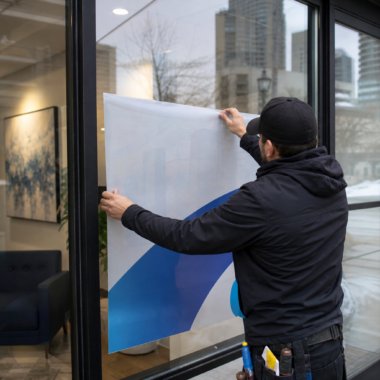
Providers may also discuss posters, window graphics, wall graphics, floor graphics, decals, or vehicle graphics as large- or wide-format applications. Do not assume that every printer offers every one of these products. Ask about the exact substrate, installation method, removal requirements, and intended environment before treating an application as suitable.
How to choose the right large-format display
Start with these five questions:
- Where will it be placed? Identify the property frontage, roadside, entrance, lobby, wall, table, or presentation area.
- How far away will viewers be? A sign read from a vehicle needs different scale and copy than a banner viewed while standing nearby.
- Is it indoors or outdoors? Outdoor exposure introduces questions about sunlight, rain, wind, temperature changes, mounting, and maintenance.
- How long will it be used? A one-day event display and a repeatedly used listing sign may require different materials, finishing, and storage considerations.
- What should the viewer do? Choose one primary action, such as finding a property, turning at an intersection, scanning a code, visiting a booth, or contacting an agent.
These decisions involve tradeoffs. Portable displays are convenient for repeated events, while installed signs may be better suited to a fixed location. More information can be useful at close range, but short copy and larger type are usually more appropriate when viewers have only a few seconds to respond.
Design principles that keep large displays readable
When choosing among large-format printing uses, prioritize large-format clarity, simple layouts, and readable scale so the message remains visible from a distance. A design that looks balanced on a computer screen may become difficult to read outdoors, across a room, or in changing light.
- Use one main message. Decide what viewers must understand first.
- Keep the hierarchy obvious. Make the headline, name, phone number, or direction stand out in the right order.
- Use strong contrast. Check text against its background, including how it may appear in bright or low light.
- Limit copy. Large surfaces do not justify filling every available area.
- Maintain brand consistency. Reuse approved logos, colours, fonts, and spacing across signs and print materials.
- Test QR codes. Scan the final artwork from a printed proof or sample distance and provide a short fallback URL when appropriate.
- Prepare the correct artwork. Confirm final dimensions, image quality, bleed, colour requirements, and whether the printer wants a press-ready file.
Outdoor large-format printing: materials and durability questions
Outdoor large-format printing must be evaluated against its actual exposure. Ask how the proposed product will handle sunlight, rain, wind, temperature changes, and repeated handling. Also confirm whether it is intended to be single-sided or double-sided, how it will be mounted, and who is responsible for installation.
For a concrete example, the listed For Sale sign offering includes weather-resistant construction, double-sided printing, and UV-resistant inks. These are useful specifications to ask about for an outdoor sign, but they should not be generalized to a different product without confirmation.
Also clarify the expected use period, storage requirements, post or frame compatibility, and whether a finish is intended to protect the print or change its appearance. If the display is permanent or subject to local rules, confirm any applicable approval or permit requirements with the relevant authority rather than assuming that temporary and permanent signage follow the same process.
Large-format printing ordering checklist
Give the printer the following information before requesting a quote or approving artwork:
- Final width and height, or the space available for the display.
- Indoor or outdoor placement and the expected exposure conditions.
- Typical viewing distance and whether viewers will be walking, standing, or driving past.
- Quantity, repeat-order needs, and expected period of use.
- Exact message, contact details, logo, colours, images, and QR code destination.
- Material, finishing, double-sided printing, mounting, post, stand, or frame requirements.
- Artwork format, dimensions, bleed, colour profile, and whether design assistance is needed.
- Required date, pickup or delivery preference, and any installation responsibility.
- Any site restrictions, building rules, or local approvals that may apply.
Turnaround, design support, and pickup considerations
Plan production around the exact display rather than relying on a general turnaround estimate. Top Realtor Sign & Print states that most products are printed within one to two business days, with same-day printing available for select products. Confirm the timing, proofing process, and pickup or delivery arrangement for the specific large-format item before setting an event or listing deadline.
If you do not have print-ready artwork, ask what support is available. The business identifies in-house graphic design and an online design tool as options for creating print materials. You should still provide the correct logo files, brokerage requirements, copy, images, and approval contact so the design can be prepared efficiently.
Frequently asked questions
What is the difference between large-format printing and wide-format printing?
They are closely related terms for oversized printed graphics. Different providers may use one term or the other, so compare the actual product, material, dimensions, finish, and intended environment instead of relying on the label.
Is large-format printing suitable for outdoor real estate signs?
Yes, some large-format products are designed for outdoor real estate use. Suitability depends on the specific material, protective finish, ink, mounting system, exposure, and expected use period. Confirm those details for the exact sign rather than assuming that every large-format print is weather-ready.
How far in advance should I order a large-format display?
Order early enough to allow for artwork review, proof approval, production, pickup or delivery, and installation. The business reports one to two business days for most products and same-day printing for select products, but the exact timing should be confirmed for your display and quantity.
Can a print shop help prepare artwork for a large-format project?
Some providers offer design support, while others expect a press-ready file. Top Realtor Sign & Print identifies in-house graphic design and an online design tool as available capabilities. Ask what file specifications, revisions, approvals, and design fees apply to your project.
Choose the display around the viewing situation
The most useful way to think about large-format printing uses is to start with the viewer’s situation. Identify the location, viewing distance, exposure, duration, and intended action, then choose the format and material that communicate clearly under those conditions.
Before approving the order, confirm the final dimensions, artwork, durability, finishing, turnaround, pickup or delivery, and installation responsibility. For large-format printing, signs, banners, and design support in Mississauga, Ontario, contact Top Realtor Sign & Print to discuss the specifications for your project.