Table tent cards are a practical choice when a short message needs to stay visible on a counter or table without someone handing out a flyer. They can support a Realtor open house, brokerage event, restaurant promotion, reception desk, community gathering, or local business offer, provided the audience is already close to the display.
The main decision is not whether the format looks attractive. It is whether your message suits a stationary, close-range display. This guide explains when table tent cards make sense, how they compare with other printed materials, and what to prepare before asking a printer to confirm current specifications, pricing, availability, turnaround, and pickup options.
What Are Table Tent Cards?
Table tent cards are printed tabletop displays designed to stand on their own. They are commonly used to present a brief promotional, informational, or directional message where people are seated, waiting, checking in, dining, or browsing.
You may also see the same general product described as table tents, tent cards, or table cards. Terminology can vary between printers, so describe the intended use and ask about the available construction rather than assuming every supplier uses the same specifications.
The format is most effective when the reader is already near the display. It is not intended to replace a large sign viewed across a room or a handout designed to travel with the audience.
When Table Tent Cards Make Sense

Use table tent cards when the placement is stable and the audience has a natural reason to pause nearby. A short message can remain in view throughout an event, appointment, meal, or visit instead of relying on a staff member to deliver it at the right moment.
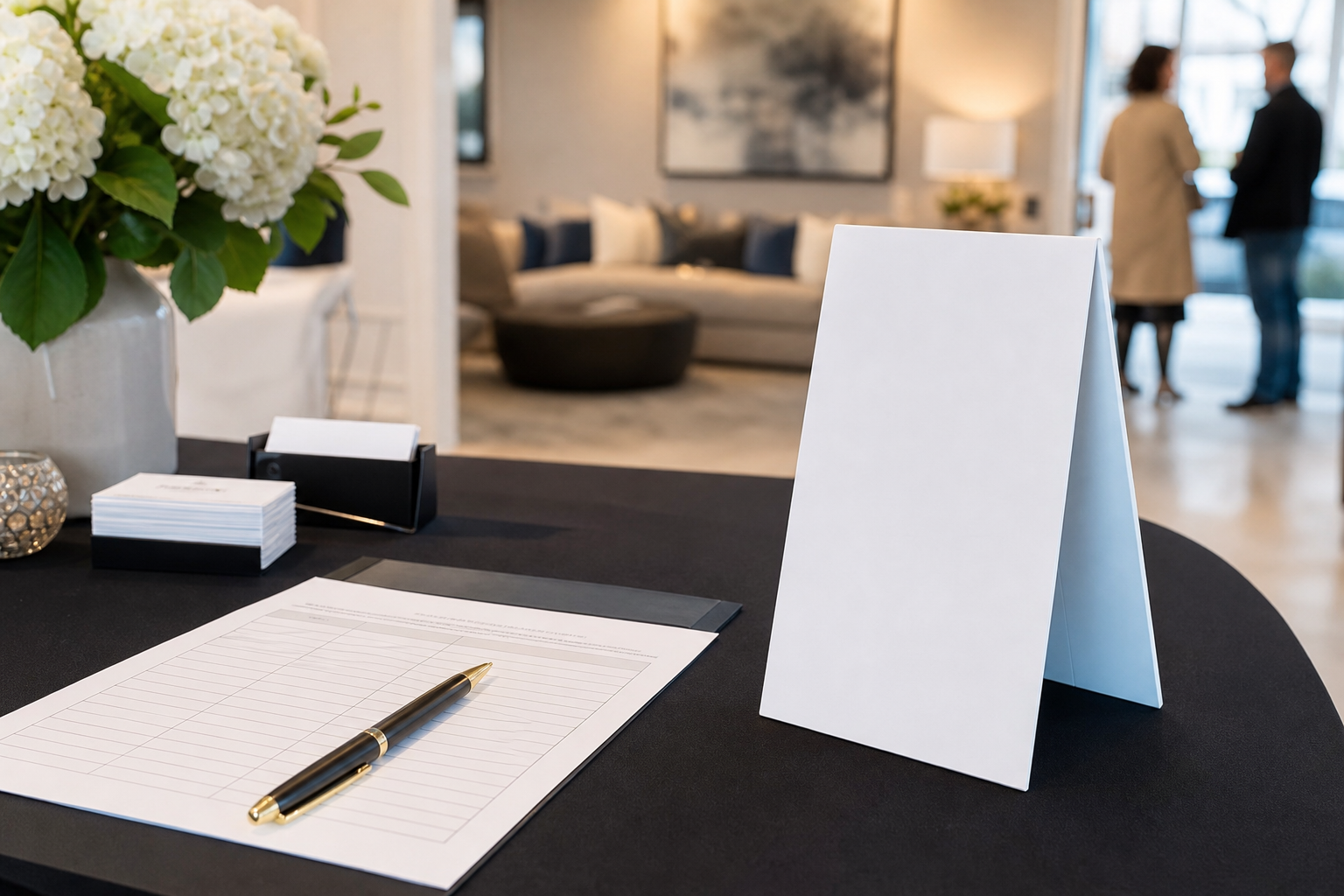
- Realtor open houses: Place one near the sign-in area, consultation table, or information station with a welcome message, viewing instruction, or clear way to request property details.
- Brokerage events: Use them on registration tables, refreshment areas, or networking tables to identify a service, prompt a conversation, or direct attendees to a resource.
- Reception desks: Present a concise service reminder, booking instruction, seasonal notice, or contact method where visitors are already waiting.
- Restaurants and cafés: Highlight one menu item, promotion, event, or ordering instruction without filling the table with printed material.
- Community and local promotions: Keep a concise announcement visible at a counter, booth, or information table where people can read it at their own pace.
They are less suitable when people are moving quickly, viewing from a distance, or expected to take detailed information with them. In those situations, a larger display or portable handout may communicate better.
Table Tent Cards vs Flyers, Postcards, and Roll-Up Banners
Each printed format solves a different communication problem. Comparing placement and reading behaviour before designing can prevent you from forcing too much information into a small tabletop display.
| Format | Best placement | Reading behaviour | Best for |
|---|---|---|---|
| Table tent cards | Tables, counters, reception desks, booths | Close-range reading while people are nearby | One short message, prompt, offer, or instruction that stays visible |
| Flyers | Handouts, displays, mailboxes, event tables | Read immediately or taken away | More supporting detail or broad distribution |
| Postcards | Direct outreach, handouts, inserts, partner displays | Quick scanning in the hand | A compact message designed for distribution |
| Roll-up banners | Entrances, stages, booths, larger rooms | Viewed while standing or walking past | Brand visibility and messages that need greater distance |
Table tent cards are the strongest fit when the audience and message share the same small physical space. Flyers and postcards are better when the reader should carry the information away. A roll-up banner is more appropriate when visibility across a room matters more than close reading.
The same principles used in effective post card design, including clear hierarchy, quick scanning, and purposeful placement, also apply to tabletop displays. The difference is that a table tent usually needs to work in a fixed location and compete with nearby activity.
Plan the Message Before Designing
Start with the action you want the reader to understand. A table tent should not attempt to explain every service, property detail, or event rule. Give it one primary job, then remove anything that does not support that job.
A useful hierarchy is:
- Main headline: State the offer, instruction, or reason to pay attention in a few words.
- Supporting copy: Add only the context needed to understand the headline.
- Brand identifier: Show the Realtor, brokerage, restaurant, business, or event name clearly.
- Next step: Provide one action, such as scanning a code, asking a representative, visiting a website, or signing up.
For an open house, the headline might welcome visitors and direct them to property information. For a brokerage event, it could invite attendees to speak with a specialist. For a restaurant, it might introduce one seasonal offer. For a reception desk, it could explain how to book or request assistance.
Keep contact details useful rather than exhaustive. Include the information needed for the intended action, and check every phone number, web address, social handle, QR code, date, and price before the artwork is approved.
Design Table Tent Cards for Quick Reading
People often encounter tabletop displays while doing something else. The design should communicate the main point before the reader studies smaller details.
Use contrast and readable type
Make the headline stand apart from the background and give body copy enough size and spacing for the expected viewing distance. Avoid placing important text over a busy photo, and do not use decorative type for information the reader must understand quickly.
Leave enough white space
White space separates the headline, supporting copy, and call to action. A crowded design can make a short message feel complicated, especially when the table already contains menus, forms, devices, or other materials.
Choose one focal image or graphic
A single property image, product photograph, logo treatment, or supporting graphic can establish context. It should reinforce the message rather than compete with it.
Consider both visible sides
If people may approach from different directions, ask whether both sides should carry the message or whether one side should face a specific queue, seat, or entrance. Confirm the printer’s available construction before preparing final artwork.
Match Placement With the Reader’s Next Step
Placement should determine what information receives the most emphasis. A display at an open-house sign-in table may need a welcome message and a simple property-information prompt. One at a brokerage registration desk may need an event instruction and a recognizable brand identifier.
Keep the most important information on the primary viewing side and place the next step where it can be found without searching. If a QR code is used, leave enough surrounding space for it to be scanned and provide a short text alternative so the instruction remains understandable without a phone.
Coordinate the table tent with the rest of the printed kit. Consistent colours, typography, logo treatment, and tone make a tabletop display feel connected to your other materials. If your display is part of a larger branded setup, compare it with soft touch business cards or other premium business card finishes so the overall presentation does not feel mismatched.
Practical Examples for Realtors and Local Businesses
Realtor open house: A tabletop display could welcome visitors, explain where to find feature sheets, or invite them to ask about comparable properties.
Brokerage event: A table tent could identify a registration process, introduce a featured speaker, or prompt attendees to visit a designated information area.
Restaurant promotion: A display might present one seasonal item or a simple ordering instruction. Avoid turning it into a complete menu.
Reception desk: A local business could use a table tent to explain a booking method, promote a relevant service, or share a short seasonal notice.
Table Tent Card Pre-Order Checklist
Prepare the following details before requesting a quote or submitting artwork:
- Final headline, supporting copy, offer details, dates, and call to action.
- Verified phone numbers, web addresses, social handles, QR codes, and contact names.
- Logo files, brand colours, fonts, imagery, and any brokerage or partner requirements.
- The intended viewing direction and whether communication is needed on one or both sides.
- Estimated quantity based on the number of tables, counters, locations, or event days.
- Where the displays will be used, including indoor conditions, available space, and expected handling.
- Your artwork deadline, event date, preferred delivery or pickup method, and proofing needs.
- A request for current product specifications, available construction, stock, finishing, price, and turnaround.
Do not assume that a specification seen on another printer’s website will be available from every supplier. Product names may be similar while dimensions, folding methods, materials, finishing options, and minimum quantities differ.
What to Confirm With the Printer
Before approving an order, ask whether the exact table tent card format is currently available and what file requirements apply. Confirm the finished dimensions, fold or self-supporting construction, paper or substrate options, print sides, finishing, minimum quantity, proofing process, and whether supplied artwork will be checked for technical issues.
Also confirm the current price, production timeline, delivery arrangements, and pickup options. Availability and turnaround can change, particularly when an event deadline is close, so get these details in writing for the specific quantity and design you need.
Top Realtor Sign & Print is a Mississauga-based provider of real estate signs and marketing materials for Realtors and local businesses. Its broader catalogue includes signs, business cards, flyers, and other printed marketing products, but table tent card availability should be confirmed directly rather than assumed from related categories.
Frequently Asked Questions
What are table tent cards also called?
They may be called table tents, tent cards, or table cards. These terms generally refer to printed displays intended to stand on a tabletop or counter, although exact construction and specifications can vary by printer.
Where do table tent cards work best?
They work best on reception desks, event tables, restaurant tables, open-house sign-in areas, brokerage displays, and community information tables. The audience should be close enough to read the display without relying on long-distance visibility.
Are table tent cards better than flyers for an open house?
Neither format is universally better. A table tent is useful for a short message that stays visible at the sign-in or consultation table, while a flyer is better when visitors should take property information or service details with them.
What information should a Realtor include on a table tent card?
Include one clear message, the Realtor or brokerage identity, only the supporting property or event information people need at that moment, and one next step. Check contact details, dates, web addresses, and QR codes carefully before printing.
What should I confirm before ordering table tent cards?
Confirm current availability, finished dimensions, construction, stock, print sides, finishing, quantity, proofing, price, turnaround, delivery, and pickup. Share the intended placement and deadline so the printer can assess whether the selected format fits the use.
Conclusion: Decide Based on Placement and Message
Table tent cards are a good fit when a concise message needs to remain visible at a table, counter, reception desk, booth, or sign-in area. They are less suitable when the audience needs a detailed handout, must view the message from a distance, or is unlikely to remain near the display.
Choose the format first, then build the design around one headline, brief supporting copy, consistent branding, and one clear next step. Before ordering, confirm the exact product specifications, current pricing, availability, turnaround, and pickup or delivery arrangements for your quantity and deadline.
For real estate signs and related marketing materials in Mississauga and Ontario, contact Top Realtor Sign & Print to confirm whether the table tent card format you need is currently available and to discuss the appropriate printing details.