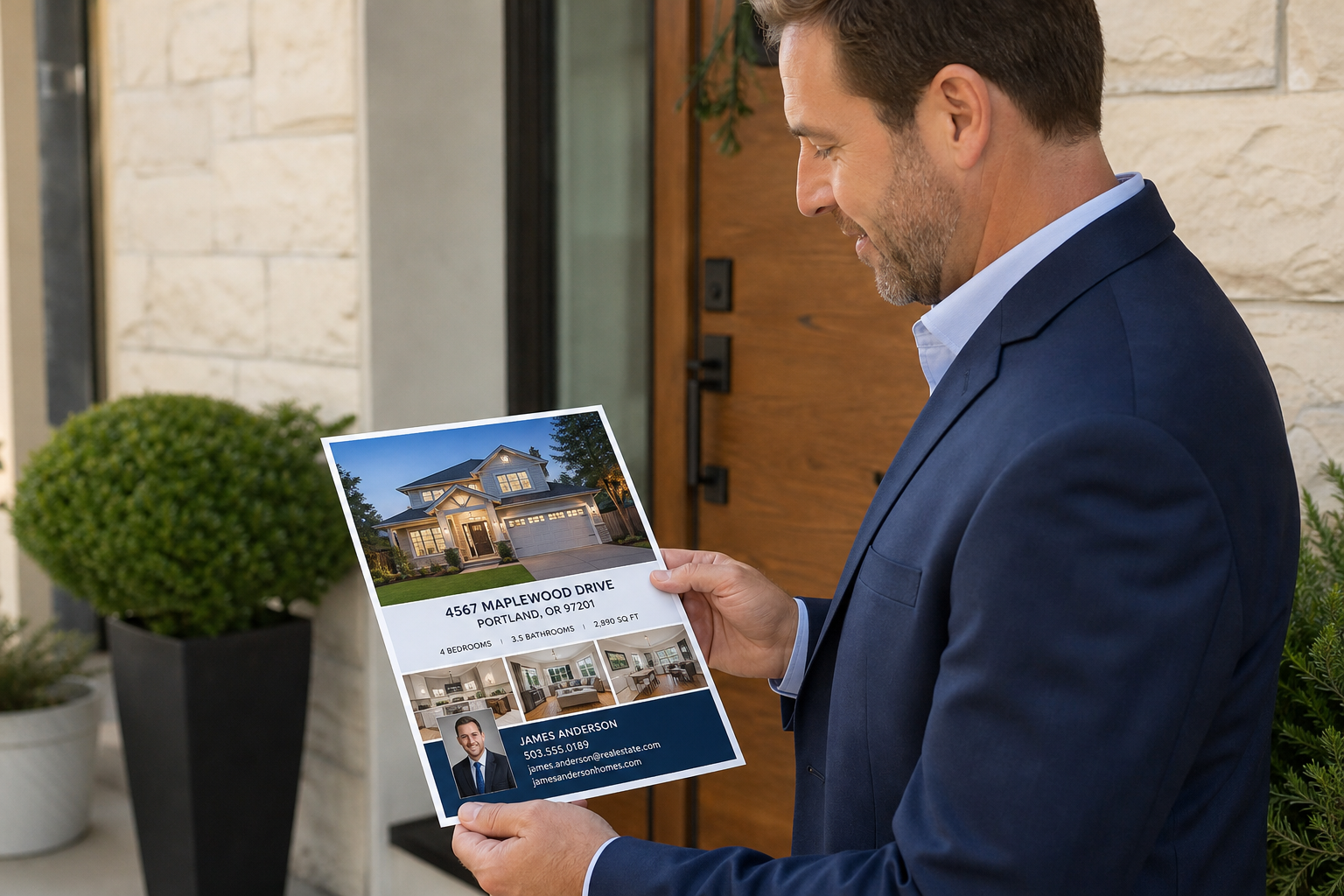
Effective real estate listing flyers make three things clear quickly: what property is being promoted, why the reader should care, and what to do next. The best design is not necessarily the most elaborate. It matches the amount of information, the distribution setting, the campaign deadline, and the agent’s brokerage requirements.
This guide explains how to choose between a simple flyer, feature sheet, and fuller property brochure, then shows how to organize the content, build a readable layout, select print specifications, and review the final artwork before ordering.
Choose the Right Listing Flyer Format
Start with the reader’s situation rather than the template. Someone walking into an open house may need a quick, portable summary. A buyer comparing properties may need a more detailed feature sheet. A neighborhood campaign may require a repeatable, economical piece that can be distributed in volume.
“Listing flyer,” “feature sheet,” and “property brochure” are useful buyer terms, but they are related formats rather than identical products in every context. The right choice depends on how much information the reader needs and where the piece will be used.
Flyer, feature sheet, or property brochure?
| Format | Best suited to | Design priority | Main tradeoff |
|---|---|---|---|
| Simple listing flyer | Open houses, showings, quick handouts, and immediate promotion | Fast scanning and one clear next step | Less room for detailed property information |
| Feature sheet | Listing information, buyer follow-up, and property comparison | Balanced layout with useful specifications and images | Requires more careful editing and information hierarchy |
| Property brochure | Higher-detail presentations, luxury listings, or extended marketing | More visual storytelling and structured detail | More content, pages, and production decisions to manage |
Match the format to the campaign
For a quick open-house handout, focus on the address or property identifier, a strong image, a concise feature summary, showing details, and the agent’s contact path. A listing launch may justify a fuller feature sheet with multiple images, specifications, and a stronger property summary.
For a buyer presentation or luxury listing, a property brochure may provide the space needed for a more considered narrative. For a neighborhood farming campaign, consistency and quantity may matter more than adding every available detail. Bulk quantity flyer printing can be relevant when a campaign calls for 2,500 or more pieces and requires consistent paper, finish, size, and single- or double-sided production.
What to Include on a Real Estate Listing Flyer

A strong flyer gives readers enough information to understand the opportunity and take the next step without forcing them through dense copy. Use the following checklist as a planning tool, then confirm required disclosures or identity elements with the brokerage and current Ontario requirements.
Essential property information
- Property identity: Include the address or another accurate identifier prominently.
- Price: If shown, verify that it is current and approved for the intended distribution.
- Key facts: Select useful specifications such as property type, bedrooms, bathrooms, approximate size, or notable features when applicable.
- Short description: Use concise, factual language that supports the images rather than repeating them.
- Showing details: Add open-house dates, times, appointment instructions, or other relevant next-step information.
- Call to action: Tell readers whether to call, email, scan a QR code, visit a website, or arrange a viewing.
Do not treat the flyer as a place to include every listing detail. Decide which facts help a reader understand the property or act on the information, then move secondary details to a feature sheet, brochure, listing page, or follow-up conversation.
Images, agent details, and contact path
Choose one dominant property image that communicates the listing clearly at the selected size. Add secondary images only when they serve a purpose, such as showing the kitchen, exterior, primary living area, or a distinctive feature. Avoid filling every available space with small images that become difficult to read in print.
Agent and brokerage information should be easy to find and read. Check the agent’s name, title, phone number, email address, website, brokerage name, logo, and approved identity elements. If you use a QR code, test it from the final proof or a printed sample and confirm that the destination is correct.
Ontario advertising requirements apply to printed flyers and other public marketing. Before approving the artwork, review current guidance from the Real Estate Council of Ontario advertising requirements and your brokerage’s policies. This is a verification step, not a substitute for legal advice.
Build a Clear, Brand-Consistent Flyer Design
Good real estate flyer design creates a predictable scan. The reader should encounter the property image and identity first, the most important facts next, and the contact path or call to action without having to hunt for it.
Use layout and hierarchy to guide the scan
A practical order is property image and identity, key facts, supporting details, agent information, and call to action. Use size, position, spacing, and contrast to show this order. A larger headline and image can establish the listing, while smaller supporting text can explain features without competing with it.
Whitespace is functional. It separates groups of information, protects legibility, and keeps the page from feeling crowded. If the design only works after reducing the text to a very small size, remove lower-priority content or choose a format with more room.
Balance brokerage branding with readability
Use approved brokerage logos, colors, fonts, and identity elements consistently, but do not let branding overpower the property information. Strong contrast, comfortable text size, and clear spacing should remain priorities across the flyer, feature sheet, sign, and other campaign materials.
Before printing, confirm that the branding is current and that agent and brokerage information is presented as required. A visually consistent flyer is useful only when its factual and identity details have also been reviewed.
Separate Design Decisions From Print Decisions
A well-organized layout can still be unsuitable for the campaign if production choices are wrong. Decide the distribution setting, information depth, size, paper, finish, sides, quantity, and deadline before finalizing the artwork.
Choose size, paper, finish, and sides
Choose a format that is easy to handle in the intended setting. An open-house handout may need portability, while a leave-behind feature sheet may benefit from more space for images and specifications. If readers may write notes on the flyer, consider whether the chosen finish supports that use.
Paper stock and finish affect how images, text, and brand colors are presented. Matte, gloss, silk, and uncoated options can create different handling and writing experiences. Single-sided printing keeps the message immediately visible, while double-sided printing provides more room without increasing front-layout density.
Choose quantity based on distribution
| Campaign | Quantity approach | What to confirm |
|---|---|---|
| Urgent open house | Small, targeted run | Product eligibility, artwork readiness, pickup timing, and proof approval |
| Routine listing launch | Enough for showings, open houses, and planned follow-up | Expected distribution, reprint needs, and storage |
| Neighborhood farming | High-volume or recurring order | Address coverage, campaign consistency, bulk pricing, and delivery or pickup logistics |
Do not order a large quantity simply because the unit cost may be lower. First estimate where the flyers will go, how long the information will remain current, and whether the price, showing details, or contact path may change.
Choose the Best Production Route
You generally have three practical routes: supply finished artwork, create the piece with an online design editor, or request professional design assistance. The right route depends on your design confidence, deadline, brand controls, and willingness to manage proofing.
- Finished artwork: Gives you the most control when your brokerage template and property content are already approved. Confirm the printer’s current file requirements before export.
- Online design editor: Useful when you need to customize a template in a browser without professional design software. Review every text field and image before submitting.
- Professional design assistance: Helpful when the layout needs to be created or substantially revised. Ask what information, logos, images, proofing stages, timing, and charges are involved.
Whichever route you choose, keep responsibility for factual review. Design support can improve organization and presentation, but the agent or brokerage should approve names, prices, dates, claims, contact details, and required identity elements before production.
Planning an Urgent Open-House or Listing Order
Same-day or next-day pickup can be useful when an open house or listing launch is close, but it should be treated as an option to confirm rather than an unconditional promise. Eligibility may depend on the selected product, quantity, artwork status, and order configuration.
Start by selecting the flyer product and defining the quantity and required pickup time. Then finalize the property content, choose finished artwork, the online editor, or design assistance, and confirm the specific timing before traveling to the pickup location. Same-day or next-day pickup is listed for the flyer product, along with design, paper, finish, size, and sidedness options.
For a local order, verify the pickup details and order reference after approval. Top Realtor Sign & Print operates at 5004 Timberlea Blvd Unit #18, Mississauga, ON L4W 5C5. Do not extend a flyer turnaround promise to signs, brochures, or other products in the same order without confirming each item separately.
Final Preflight Checklist Before You Print
- Confirm the property address, price, dates, times, and factual specifications.
- Check the agent name, phone number, email address, website, brokerage name, and approved logo.
- Review the headline, feature summary, spelling, punctuation, and calls to action.
- Open and test every QR code, web address, email address, and phone number.
- Confirm image quality, cropping, orientation, and the intended reading order.
- Check contrast, text size, whitespace, margins, and the printer’s current file requirements.
- Confirm paper stock, finish, size, single- or double-sided printing, and quantity.
- Review current Ontario advertising guidance and brokerage approval requirements.
- Approve the final proof before production, then verify pickup or delivery details.
For larger digital campaigns that support a listing, review listing digital marketing strategies for Toronto sellers alongside your print plan. Print and digital materials should use consistent property facts, branding, and contact information.
Frequently Asked Questions
Should a real estate listing flyer be single-sided or double-sided?
Choose single-sided printing when the message must be visible immediately or when the flyer will be displayed with one side facing outward. Choose double-sided printing when you need additional room for property details, images, or agent information.
What is the difference between a listing flyer and a feature sheet?
A listing flyer usually prioritizes quick scanning and immediate promotion. A feature sheet generally provides more structured property information and may be used as a leave-behind or follow-up document. The terms can overlap, so confirm the intended format and content rather than relying on the name alone.
Can Realtors order listing flyers for same-day pickup in Mississauga?
Same-day or next-day pickup is available for the listed flyer product, but eligibility should be confirmed for the specific quantity, artwork, and configuration. Finalize the content, select the product, approve the proof, and verify pickup timing before relying on an urgent deadline.
When does bulk quantity flyer printing make sense for a neighborhood campaign?
Bulk printing becomes relevant when you have a defined distribution area, a stable message, and enough recipients to justify a high-volume order. Confirm that the price, contact information, and campaign details will remain current before ordering thousands of pieces.
Should I use an online design editor or request professional flyer design assistance?
Use an online editor when you have approved content and want to manage straightforward customization yourself. Request design assistance when the layout, branding, image selection, or information hierarchy needs expert support. In both cases, review and approve the final proof yourself.
Conclusion: Choose the Format That Fits the Listing
Use a concise flyer when the reader needs a fast property summary, a feature sheet when buyers need organized specifications and supporting images, and a fuller brochure when the listing or presentation calls for more detail. Then match the paper, finish, sides, quantity, and production route to the way the material will be distributed.
The most reliable workflow is simple: finalize factual content, build a clear hierarchy, confirm branding and advertising requirements, select production specifications, review the proof, and verify timing. For local flyer printing, design assistance, and real estate marketing materials, visit Top Realtor Sign & Print to review available options and confirm order details.