When you choose raised spot UV business cards you pick a tactile, glossy highlight that rewards close inspection. This article compares raised spot UV with foil and full or flood UV across look and feel, brand signal, legibility, design constraints, file-prep, and ordering options for Ontario realtors. Use the checklists and persona recommendations below to decide whether texture or metallic impact fits your listing and networking needs.
What raised spot UV is and how it works
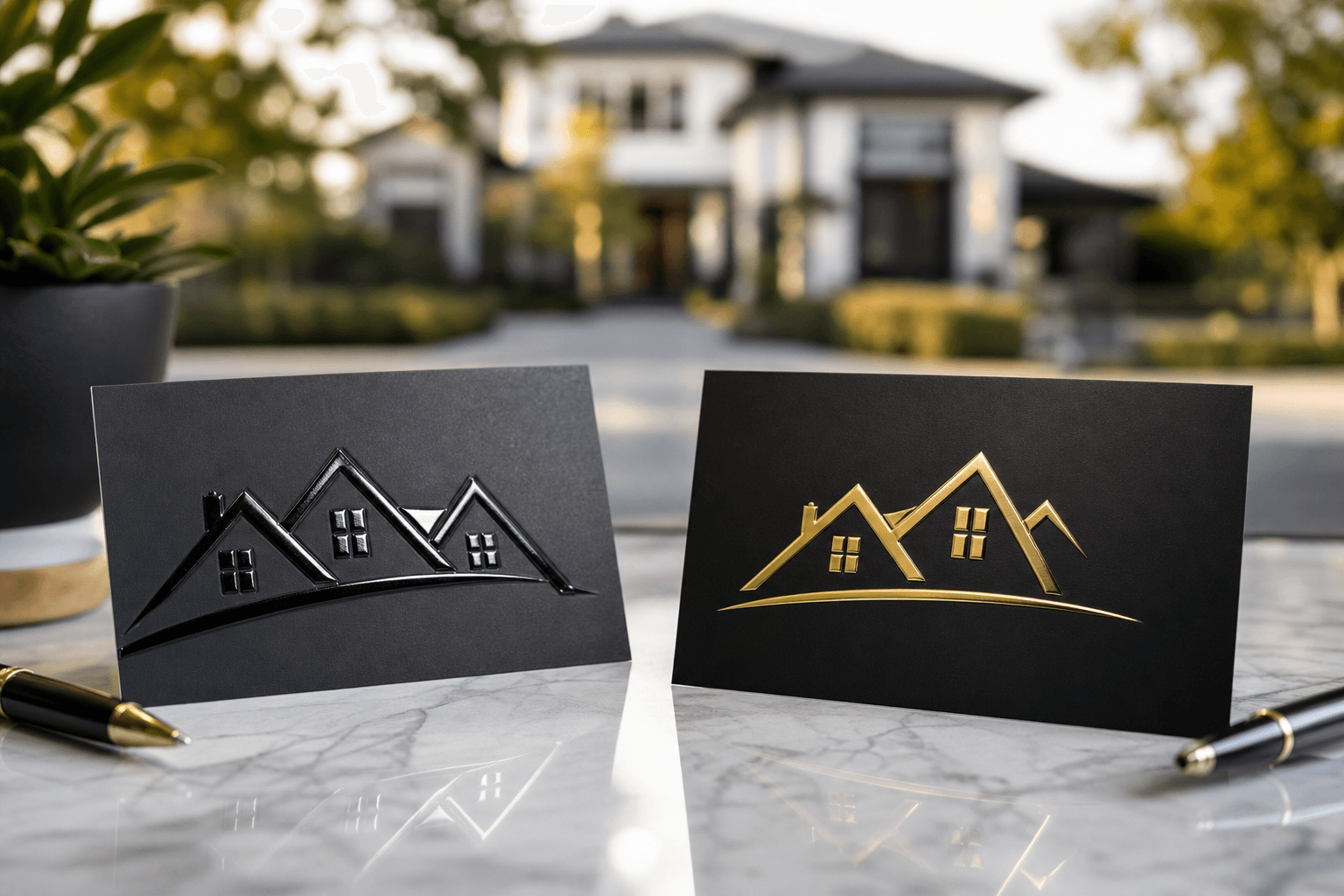
Raised spot UV applies a clear, glossy varnish only to selected areas of the card, then cures the coating with ultraviolet light so the varnish builds a slightly elevated, tactile surface. The finish produces glossy highlights and a texture you can feel, which helps logos and accents stand out against a matte stock. For a technical overview of the process and typical production options see this raised spot UV guide from Print Peppermint (Print Peppermint spot UV guide).
Industry guides explain the difference between flat spot UV and raised spot UV and the situations where each makes sense, which is useful when you brief a printer or a designer.
Flat spot UV versus raised spot UV
Flat spot UV is a thin, glossy application that looks reflective without adding much texture. Raised spot UV uses thicker layers to create a perceptible relief. Pick flat spot UV when you want a subtle shine that does not alter card thickness. Choose raised spot UV to add tactility and a visible contour that people notice when they touch the card. Production methods, machine settings, and curing steps differ, so confirm which variant your supplier offers before you send artwork. Practical differences and visual examples are outlined by specialty printers and trade guides from The Print Warehouse and Print Peppermint (The Print Warehouse) and (Print Peppermint).
Raised spot UV compared with foil and flood (full) UV
Decide between these finishes by asking what message you want the card to send and how it will be used. The short comparison below highlights how each finish performs for realtors.
Look and feel
- Raised spot UV, clear, glossy highlights with a textured, tactile feel that invites handling.
- Foil, metallic colour and reflective shine that reads as premium and attention grabbing.
- Flood or full UV, glossy sheen across most or all of the surface, creating uniform shine rather than selective highlights.
Spot UV highlights texture and subtlety, whereas foil makes a bold metallic statement. If you need full-surface gloss choose flood UV instead of trying to cover most of the card with spot UV, which defeats the selective-contrast purpose. For a practical comparison see Print Imposition’s notes on spot versus full UV (Print Imposition).
Brand signal and use cases
- Raised spot UV, best for design-led, boutique, or luxury presentations where tactility supports a high-end feel. Use it on logos, monograms, or a textured back panel to reward close inspection.
- Foil, works for luxury listings, branded event invitations, or agent materials that must stand out visually at a distance.
- Flood UV, choose when you want a glossy, saturated surface across the entire card, such as for vivid photography or strong colour coverage.
For guidance comparing spot UV with foil and which finish suits different brands see a practical comparison from a Canadian printer and an industry blog from YAYA Prints (YAYA Prints).
Readability and reflection
High-gloss areas can cause glare under direct light, which may affect legibility for small type placed inside a glossy spot. If your design relies on very small details use spot UV sparingly and avoid applying it over critical small type. For foil, metallic reflectivity can also reduce readability at some angles, so contrast and type size matter.
Design rules and recommended coverage for raised spot UV
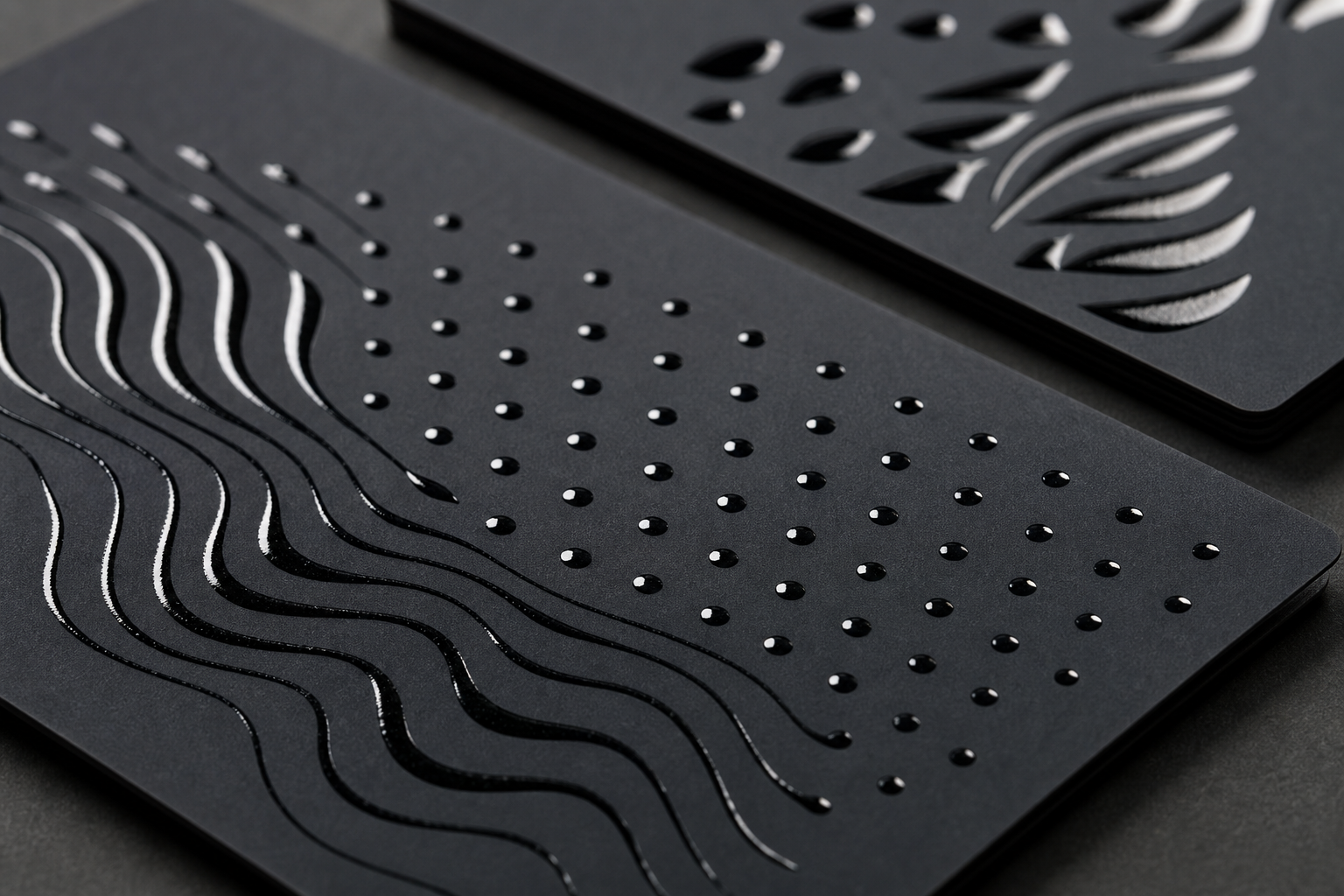
Designers and printers recommend using spot UV selectively to preserve contrast between glossy and matte areas. A common practical rule is to keep decorative spot UV coverage low, for example below about 20 percent of the card surface, and to target it to logos, icons, or accent shapes where it creates visual emphasis. Over-application of spot UV, such as covering the majority of the card, weakens the effect and is a signal to use flood UV instead. See The Print Warehouse and Print Imposition for context (The Print Warehouse) and (Print Imposition).
Practical placement tips for realtors
- Apply raised spot UV to the logo mark or a single headline word for tactile emphasis.
- Avoid placing raised spot UV directly over type smaller than 6 to 8 points unless you confirm with a preproduction proof.
- Use spot UV on the back of the card as a pattern or texture to give a premium feel without affecting front-side legibility.
- Test contrast on a print proof because glossy varnish changes perceived contrast against a matte stock.
File-prep and prepress checklist to avoid production surprises
Follow these exact steps when preparing artwork for raised spot UV. Many printers prefer a separate varnish channel or spot colour to indicate where the coating should be applied. Exact file requirements vary, so share these files with your printer or design partner in advance and confirm their preferred PDF standard.
- Prepare a CMYK print file for the artwork and a separate spot layer named clearly for the varnish, for example “SPOTUV” or “VARNISH”.
- Set the spot channel to 100 percent where varnish is needed and 0 percent elsewhere. Do not use a halftone for the varnish layer unless the printer requests it.
- Export to PDF/X-1a or PDF/X-4 if the printer accepts it, because these formats preserve spot colours and overprint settings reliably. Ask your vendor if they require a different standard.
- Include trim, bleed, and safe text margins, and indicate registration tolerances for the varnish. Varnish can shift slightly, so avoid placing critical detail on thin varnish borders.
- Order a physical proof for raised spot UV or request a digital mockup and a production note confirming whether the finish is flat or raised.
For more on production options and lead times printers document their delivery tiers and variants, which helps you plan around listing and open-house schedules. If you need file help consider working with an in-house design service such as Top Realtor Shop’s team (Print Peppermint).
Cost, lead time, durability and legibility tradeoffs
Raised spot UV commands a premium over uncoated or standard matte cards because it adds production steps and materials. Lead times are typically longer than plain business cards but variable by vendor and production tier. Raised spot UV can remain durable in a wallet, though high-gloss spots can show abrasion over time depending on handling and the varnish thickness. If you need metallic colour or a dramatic reflective accent choose foil instead, understanding that foil and raised varnish create different tactile and visual signals (YAYA Prints).
Common objections realtors raise and how to address them

- Objection: Raised spot UV makes small text hard to read. Answer: Keep text off glossy spots or enlarge to a safer size, and request a proof to confirm legibility.
- Objection: It will not fit my budget. Answer: Use spot UV on one side only or on a single element such as the logo to control cost while keeping the premium effect.
- Objection: I need cards fast. Answer: Confirm production tiers with your printer and ask whether basic business cards are available for same-day pickup while special finishes may require extra days.
Trade guides and specialist printers discuss these tradeoffs and offer tiered production options so you can match finish to timeline and budget (Print Peppermint).
Decision criteria and quick recommendations for real estate personas
Use this quick decision flow and persona guidance to pick a finish fast.
- Luxury listing agent, goal: communicate premium service and attention to detail. Recommendation: raised spot UV for tactile logos plus selective foil accents if the budget allows.
- High-volume agent, goal: affordable, clear, and recognisable cards for mass distribution. Recommendation: matte or soft-touch stock with minimal spot UV for a subtle texture, keep one-sided application to reduce cost.
- Boutique or design-led agent, goal: distinctive, brand-led presentation. Recommendation: raised spot UV on the logo with a textured back pattern to encourage handling and referrals.
How to order raised spot UV business cards locally from Top Realtor Shop
Top Realtor Shop is a Mississauga print and signage provider that serves realtors across Ontario and offers in-house design services and an online editor for quick artwork creation. The shop lists spot UV products under the site tag for spot uv card and advertises same-day pickup on key items like business cards, which is helpful when you need urgent local collection (Top Realtor Shop).
Practical ordering steps
- Decide the finish and coverage you want based on the guidance above.
- Use the online design tool or upload your CMYK print PDF plus a separate spot layer named for varnish.
- Ask for a proof and confirm whether the shop will produce raised or flat spot UV for your job.
- If you are on a tight timeline, check same-day pickup options for business cards and confirm whether your chosen finish is available on that schedule.
Frequently asked questions
How much of my business card can I reasonably cover with raised spot UV?
Industry guidance suggests keeping spot UV coverage low, for example under about 20 percent of the surface, and applying it selectively to logos, icons, or accent shapes. If you want shine across most of the card consider flood UV instead (The Print Warehouse) and (Print Imposition).
Will raised spot UV affect the readability of small type or fine lines?
Yes, glossy varnish can reduce contrast and cause glare, so avoid placing very small type or delicate hairlines inside a spot unless you confirm with a printed proof. When in doubt increase type size or move the varnish away from the text.
How should I set up my artwork file so the printer produces raised spot UV in the right places?
Create a separate spot colour or varnish layer labelled for the varnish, set that channel to 100 percent where you want coating, and export to a PDF/X standard that preserves spot colours. Confirm the printer’s preferred file standard before submission and request a proof (Print Peppermint).
Is raised spot UV more fragile than foil or standard finishes and how does it hold up in a wallet?
Raised spot UV is durable but can show abrasion on high-contact edges over time depending on handling and varnish thickness. Foil is generally resistant to scuffing but can crease if bent. Ask the printer about varnish thickness and real-world durability for wallets or cardholders.
Can I get raised spot UV business cards the same day in Mississauga?
Top Realtor Shop advertises same-day pickup for key items such as business cards, but special finishes like raised spot UV may require additional production time. Confirm availability and lead time with the shop before placing an urgent order (Top Realtor Shop).
Ready to make a choice or get a proof? Visit Top Realtor Sign & Print to view spot UV options and start a design or upload your file Top Realtor Sign & Print.