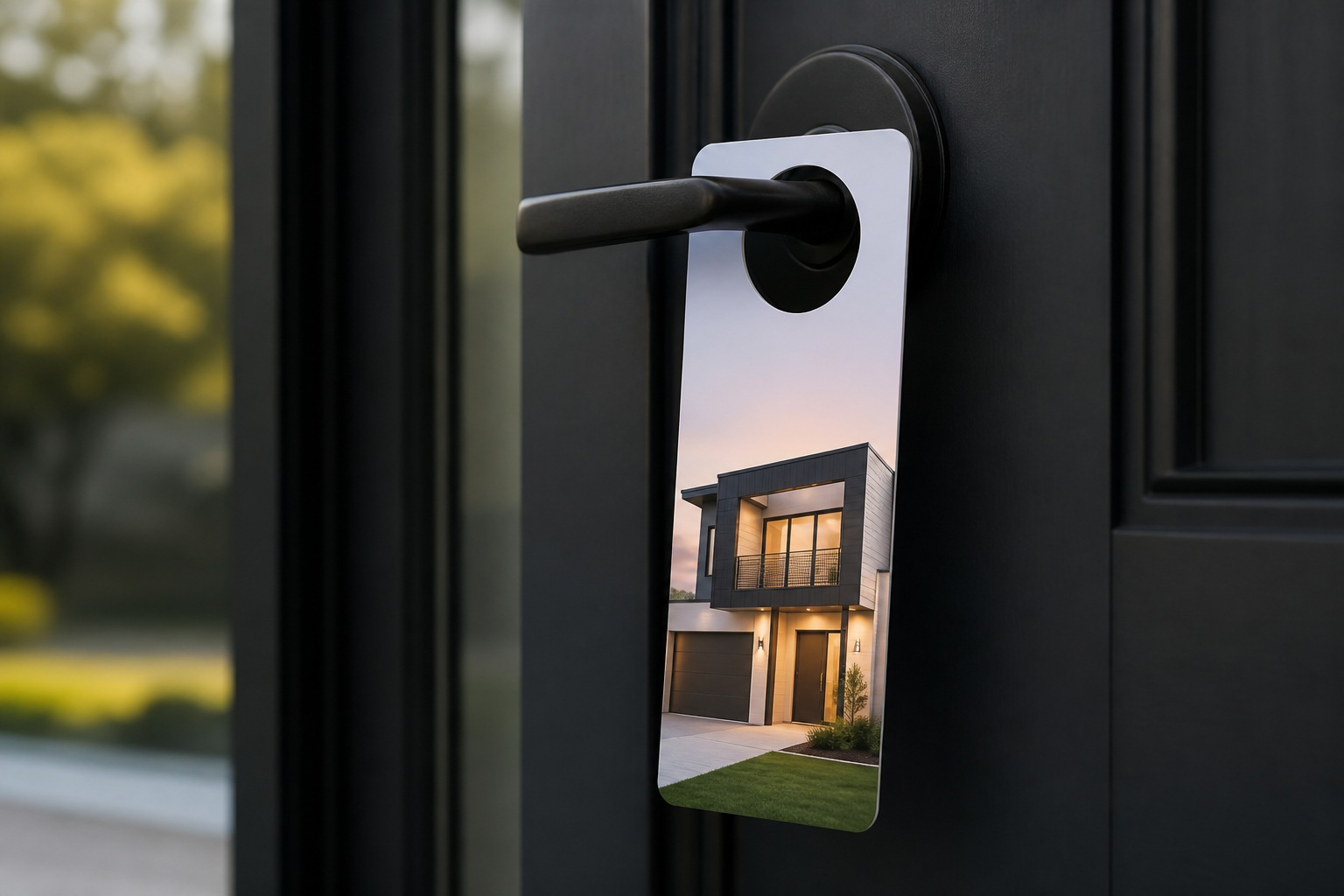
A Practical Guide to Promotional Door Hangers
Promotional door hangers are a simple, high-visibility way to put your message right into a customer’s hand—literally at their doorstep. Whether you’re announcing an event, launching a service, promoting a local offer, or introducing a new location, door hangers can deliver targeted impressions without competing for attention on a crowded screen.
This guide walks you through every stage of a successful door hanger campaign: clarifying your objective, crafting standout design and copy, choosing practical print specs, planning distribution, and measuring results. Use the frameworks and checklists below to make confident, repeatable decisions and improve performance over time.
What are promotional door hangers?
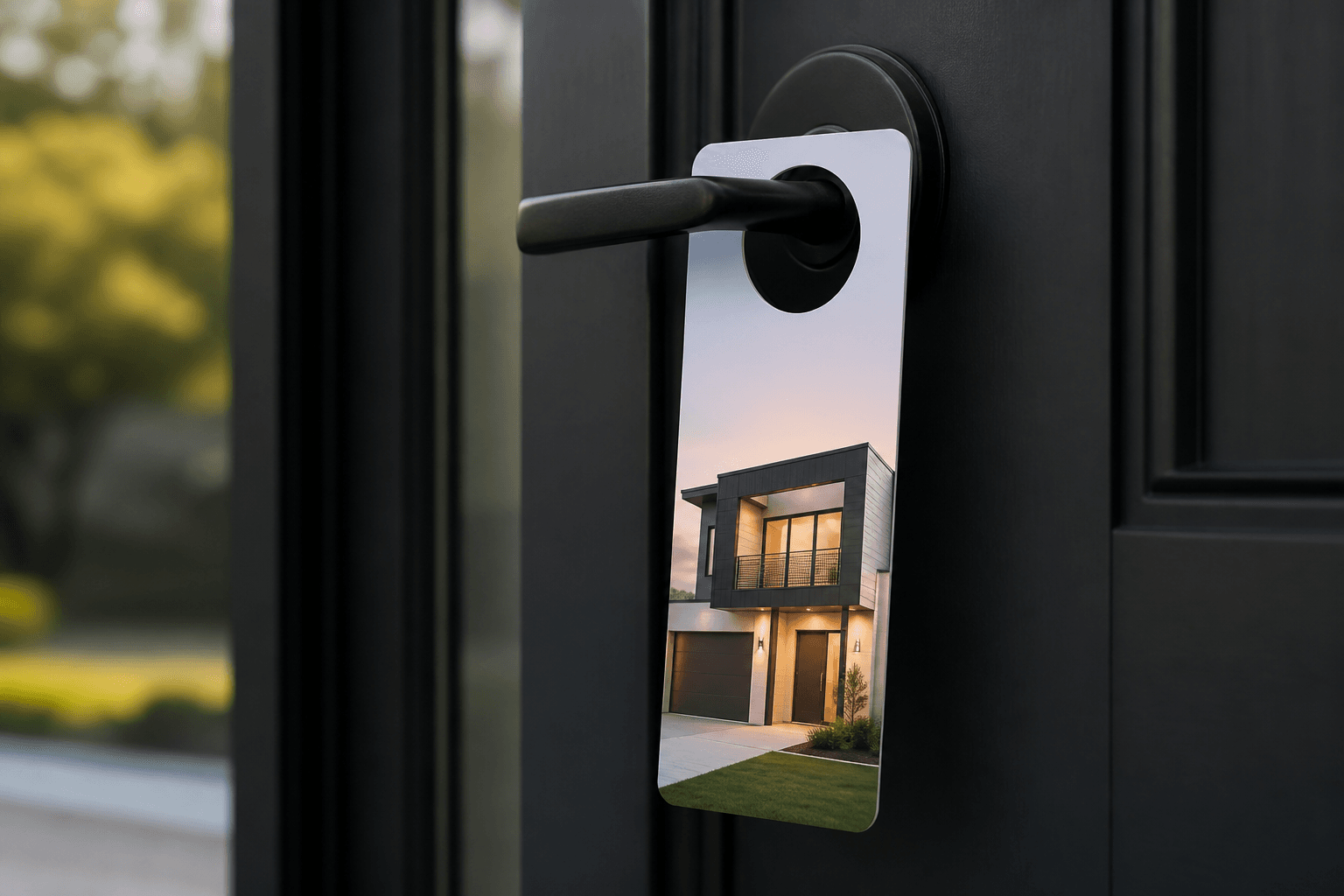
Promotional door hangers are printed pieces with a die-cut hole or slit that slide over a door handle. Their placement creates a one-to-one touchpoint with the household or business behind the door. Because they’re encountered in a low-distraction setting, they’re well-suited for concise messages and clear calls to action.
Common use cases include:
- Local service introductions (home services, fitness, healthcare, professional services, restaurants)
- Community events and seasonal promotions
- Grand openings, new hours, or menu updates
- Real estate farming, open house announcements, and neighborhood updates
- Membership drives and nonprofit campaigns
Unlike mass media, door hangers can target specific streets, buildings, or zones, giving you control over who sees your message and when they see it.
When to use door hangers
Choose promotional door hangers when the following conditions align:
- Local relevance: Your offer or event applies to a defined geographic area.
- Clear, single action: You want recipients to do one thing now (visit, call, scan, RSVP).
- Timing sensitivity: The message is time-bound (e.g., weekend event, limited-time service window).
- Competitive whitespace: You prefer a tactile format that avoids digital ad fatigue.
Door hangers pair especially well with other channels. For example, drop a hanger two days before an email reminder, or follow a neighborhood flyer campaign with a door hanger carrying a stronger incentive.
Design that gets doors opening
Good design is the difference between a glance and engagement. Use these principles to ensure your promotional door hangers are noticed and understood in seconds.
- Hierarchy first: Decide your #1 takeaway (e.g., “Free estimate” or “Open House Sat 2–4 PM”) and make it dominant. Secondary details should be visually subordinate.
- Readable from arm’s length: Headline type should be legible from roughly 3–4 feet. Favor high-contrast color combinations and sufficient line spacing.
- Front-back purpose: Use the front for hook + primary CTA; reserve the back for details, FAQs, map, or testimonial quotes (if applicable).
- Whitespace is a design tool: Don’t fill every inch. Breathing room guides the eye and improves comprehension.
- Brand continuity: Align colors, fonts, and tone with your existing materials so recipients can connect the piece to your business quickly.
- Scannable elements: QR codes pointing to a mobile-friendly page reduce friction and let you track engagement.
Sample front layout (top to bottom):
- Logo or brand mark (small, top corner)
- Primary headline (large, benefit-led)
- Subhead (one-line clarifier)
- Visual or icon row (optional)
- Primary CTA with contact method (button-style block, high contrast)
- QR code + short URL (redundant access)
Copywriting that converts
Door hangers live and die on clarity. Use tight, benefit-driven language and a single, unmistakable call to action.
- Lead with value: State the outcome the recipient cares about, not your internal process.
- One action only: Choose the most valuable next step (call, book online, visit) and remove competing CTAs.
- Microcopy matters: Tiny lines near the CTA (e.g., “Takes 30 seconds” or “No sign-in needed”) can lift response.
- Local cue: Name the neighborhood or area on the piece when relevant to increase relevance.
- Urgency with integrity: Time-boxed offers or event dates provide a natural reason to act without overpromising.
Plug-and-play headline formulas:
- “This weekend only: [Benefit] for [Audience] on [Street/Area]”
- “A faster way to [Desired Outcome]—right here in your neighborhood”
- “New on your block: [Service/Product]. Scan to get [Simple Incentive].”
CTA examples:
- “Scan to book your spot” (QR to booking page)
- “Call now for details” (prominent phone number)
- “Bring this hanger for entry” (event checkpoint)
Practical print specs and finishes
Your specifications should support legibility, durability, and handling. Consider the following factors as you prepare files for printing:
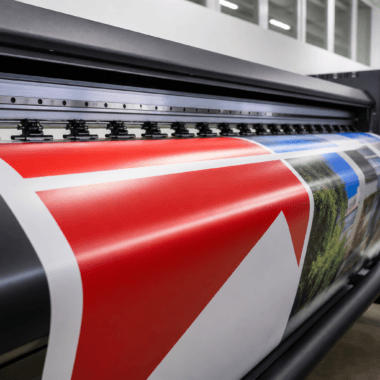
- Size: Common formats include slim (approx. rack card dimensions), standard (around half-sheet), and large for more visual impact. Larger sizes increase visibility but may add weight.
- Paper weight: A heavier cover stock resists bending and feels more substantial in hand. Choose a thickness that holds its shape on the handle.
- Finish: Gloss can enhance photos and color vibrancy; matte or satin improves readability and reduces glare. Select based on imagery and brand feel.
- Die-cut style: Circular hole or slit designs both work; a slit can be faster to place in the field. Ensure adequate margin around the hole to prevent tearing.
- Bleed and safe area: Extend background colors and images past the edge (e.g., 1/8 inch bleed) and keep key text within a safe area to avoid trimming issues.
- File prep: Provide print-ready PDFs with outlined fonts, embedded images at sufficient resolution, and CMYK color.
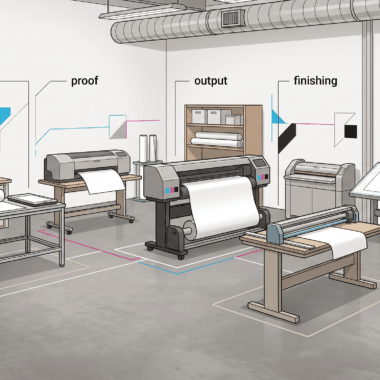
Tip: If your hanger includes a detachable coupon or business card panel, confirm perforation placement and folding direction during proofing to avoid conflicts with the door cutout.
Distribution strategy and ethics
Getting promotional door hangers into the right hands—respectfully and efficiently—is half the battle. Plan your drop to maximize relevance and maintain goodwill.
- Target selection: Map streets or buildings with the highest concentration of your ideal customers. Prioritize proximity to your location or service area.
- Timing: Distribute when recipients are most likely to notice (e.g., mornings for service offers ahead of the day, or mid-week for weekend events).
- Respect property and preferences: Observe posted notices and local property rules. If in doubt, skip a door and move on.
- Weather plan: Moisture-resistant stocks or protective poly bags can help in wet conditions. Avoid distribution during heavy rain or strong winds.
- Recordkeeping: Note streets covered, quantities dropped, and timing to correlate later with response data.
Tracking and measurement
Every batch of promotional door hangers should have a measurement plan. Even basic tracking turns a one-time drop into a learning engine for better ROI next time.
- Unique URLs: Use short, memorable URLs specific to the campaign or neighborhood so you can attribute visits.
- QR codes: Generate campaign-specific QR codes leading to a mobile-optimized page. Monitor scans and on-page conversions.
- Offer codes: Add a simple code (e.g., OAK-23) to track redemptions at checkout or over the phone.
- Dedicated phone extension: If possible, use a unique extension or recorded line to attribute calls.
- Time-stamped drops: Record distribution windows to observe response curves and refine timing.
Core metrics:
- Distribution volume: Number of hangers placed
- Response rate: Responses divided by hangers distributed
- Conversion rate: Purchases or bookings divided by responses
- Cost per acquisition (CPA): Total campaign cost divided by conversions
- Return on ad spend (ROAS): Revenue attributed to the campaign divided by campaign cost
Use controlled variations (A/B tests) of headlines, incentives, or CTAs across neighboring zones to identify what lifts response. Change one variable at a time for clean readouts.
Budgeting and ROI basics
While exact costs vary, the structure of a door hanger budget is consistent. Thinking in unit economics helps you gauge feasibility before you print.
- Fixed costs: Design time and one-time setup
- Variable costs: Printing and finishing per unit, distribution labor, accessories (e.g., bags)
- Attribution: Tracking tools (QR, short links), landing page build
Basic break-even model:
- Estimate response rate (e.g., percentage of recipients who scan, call, or visit).
- Estimate conversion rate from response to purchase or RSVP.
- Calculate expected revenue per conversion.
- Work backward to find the maximum allowable cost per hanger that preserves margin.
If your first campaign is exploratory, print a modest, testable quantity and apply rigorous tracking. Reinvest in the best-performing headline, incentive, and neighborhood combinations.
Door hanger campaign checklist
- Define one objective (e.g., “Book 40 appointments” or “Drive 200 scans”).
- Set a single primary CTA and supporting microcopy.
- Choose size, stock, finish, and die-cut style aligned to the message.
- Create front for hook + CTA; place details on the back.
- Generate unique URL, QR code, and offer code.
- Proofread and preflight files (bleed, safe area, resolution, CMYK).
- Map target streets/buildings; set dates and distribution windows.
- Brief team on etiquette and recordkeeping.
- Measure responses, conversions, and CPA; document learnings.
- Iterate with a single-variable test for the next drop.
FAQs
How many promotional door hangers should I print for a first campaign?
Start with a quantity that covers your highest-priority streets or buildings while leaving budget for a second iteration. A phased approach lets you test and refine messaging before scaling.
What should go on the back of a door hanger?
Use the back for essentials that support the front’s main promise: brief bullets, a simple map or schedule, a short FAQ, or redemption instructions. Keep paragraphs short and scannable.
Are QR codes necessary on door hangers?
They’re not required, but they reduce friction and improve attribution. Pair a QR with a short, memorable URL for those who prefer to type.
What’s the best day of the week to distribute?
It depends on your goal. For weekend events, mid-week drops can prime interest; for service bookings, mornings earlier in the week may encourage faster action. Record results and adjust based on your data.
Should I include a discount?
Only if it reinforces your objective. Alternatives like a free consultation, bonus add-on, or early-access RSVP can motivate action without conditioning recipients to wait for discounts.
Next step: If you’re ready to create promotional door hangers, visit Top Realtor Sign & Print to explore options and get started: https://toprealtorshop.ca/