Choose sign dimensions by matching viewing distance, placement, and local rules, not by instinct. This checklist gives seven clear decisions that tell you which open house sign sizes work best for sidewalks, yards, busy intersections, and directional routes. Each item explains when to use the size, layout and mounting tips, common objections, and a practical takeaway. Before you post any off-site directionals, confirm municipal or HOA limits for your neighbourhood, because rules vary across Ontario and can restrict size, number, hours, or placement (see the example municipal rules cited below).
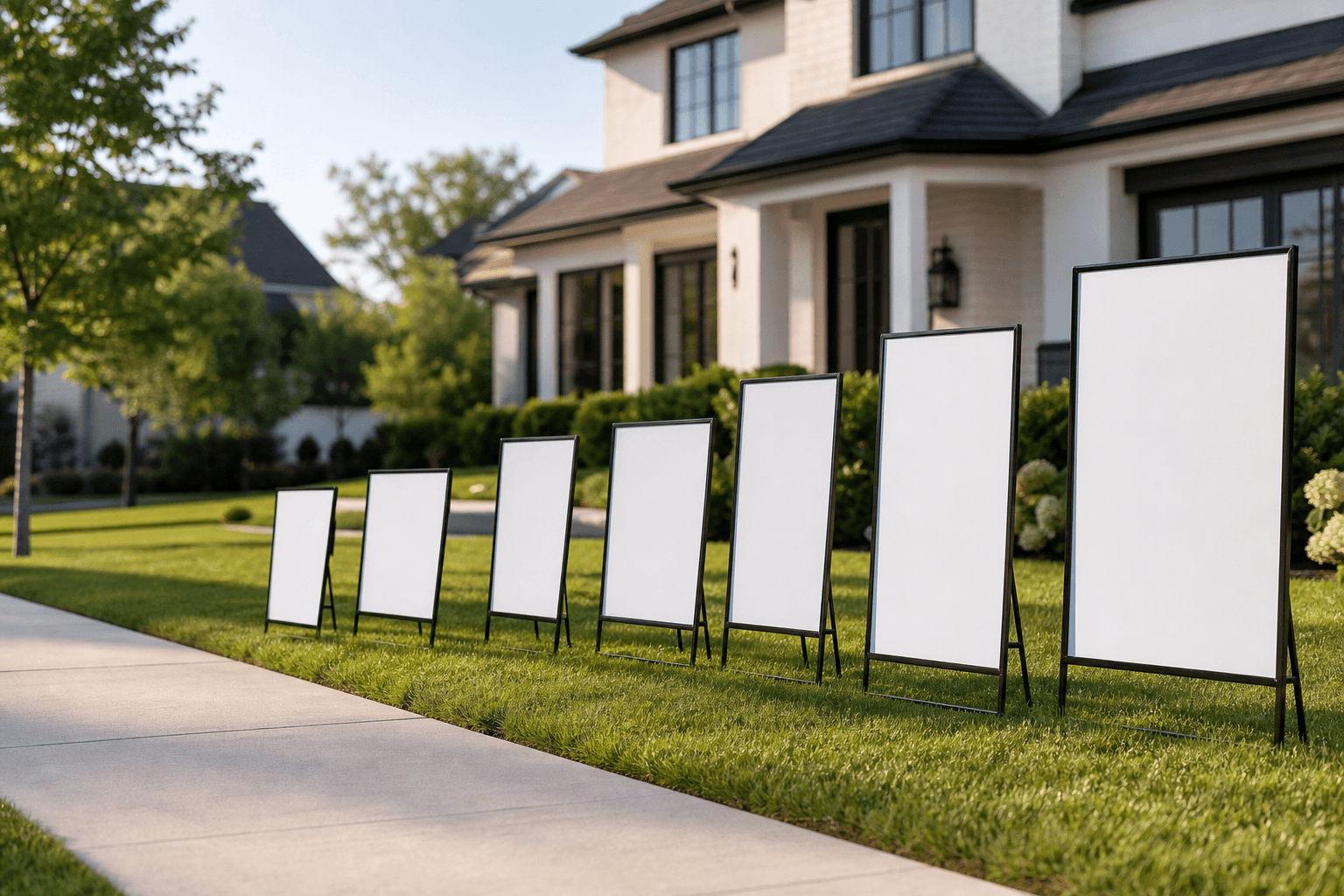
These choices follow standard industry guidance: use 12 x 18 inches for foot-traffic placements, 18 x 24 inches as the standard yard size, and 24 x 36 inches when drivers must read at speed or from farther away. Design for legibility first, and prioritise the headline and contrast over decorative elements so your message registers in the few seconds a passerby or driver has to read it.
1) Use 12 x 18 inches for pedestrian-focused placements and sidewalk boards
When to use it. Choose a 12 x 18 inches sign when most viewers are on foot or will stop near the board: sidewalk placements, registration tables at the door, or A-frame sandwich boards where passersby pause. Industry guidance groups 12 x 18 inches as the sidewalk or walk-up size and recommends portrait or compact landscape orientations for these spots (PrintPlace real estate sign sizes).
Copy and mounting
Limit copy to a strong headline and one short line of detail. Use an A-frame, small H-wire stake, or portrait sign holder. For pedestrian reads you can include a small logo or QR code because viewers are close enough to scan or read finer type.
Why this decision matters
If drivers must read the same sign at speed, 12 x 18 will not be legible. Use this size only where viewing distance is under about 6 metres and walking speed applies. If there is any doubt that passing traffic must read the message, choose a larger size.
2) Use 18 x 24 inches for standard yard and on-site open house signs
When to use it. Make 18 x 24 inches your default yard sign for most suburban listings. This size fits every standard frame and H-wire stake widely sold, and it reads well from typical residential streets, which is why it is commonly recommended as the standard real estate yard sign (YardSignPlus guide to sign sizes).
Recommended layout
Follow a clear copy hierarchy: headline (Open House or For Sale) largest, then address or time, then agent contact. Mount on a mid-height H-wire stake for visibility from the curb or use a post-and-panel for a premium look. Add riders for status (Open House, Sold) where permitted.
Practical takeaway
Use 18 x 24 for on-site presence unless the sign faces a busy arterial. If you expect higher vehicle speeds or the sign will be read from a greater distance, plan to upgrade to a larger panel.
3) Use 24 x 36 inches for intersection placements and fast-moving traffic

When to use it. Upgrade to 24 x 36 inches for corner lots, busy intersections, and arterial roads where drivers need to read while moving. Experts recommend larger 24 x 36 panels when visibility from speed or distance is required because the extra size increases legibility and reduces the need for tightly packed copy (YardSignPlus, PrintPlace overview).
Design and mounting tips
Use a large, single-line headline and a short single-line address. Mount higher for sightlines and use a robust frame or coroplast backed by a post. For two-way traffic consider double-sided printing so drivers in both directions see the message.
Watchouts
Larger panels can trigger municipal or HOA restrictions and typically require sturdier hardware. Check local sign rules before ordering to avoid fines or removal.
4) Use landscape medium signs for directional arrow signs and route guidance
When to use it. For directional guidance choose a medium landscape format, commonly an 18 x 24 landscape or a wide 24 x 18, with an oversized arrow and a single address line. Directionals are designed to be read quickly during turns, so keep copy minimal and the arrow very prominent. A practical industry rule is to reduce copy first before increasing artwork complexity if drivers must read while moving (PromotionChoice yard-sign guide).
Best practice for route signs
- Double-sided printing for two-way visibility.
- One address line maximum to avoid clutter.
- Place signs at decision points rather than every block. A starter set of 6 to 12 directionals is common depending on distance and turns required (ARTO Sign package checklist).
Practical takeaway
Use medium landscape signs with oversized arrows to guide traffic; reduce the number of words and use double-sided prints where drivers approach from both directions.
5) Run municipal and HOA checks before you place off-site and on-site signs

What to check. Local sign bylaws and HOAs often limit sign face area, number of off-site directionals, allowed placement distance, and permitted hours. For example, some municipal codes restrict the number of off-site directionals and set hours of placement for open house signs. Always confirm the local bylaw before planting signs (Ontario sign regulations example).
Checklist before posting
- Confirm maximum sign face area and allowed heights.
- Ask about limits on off-site directional signs and how far from the listing they may be placed.
- Check allowed days and hours and removal rules for events like open houses.
- If in an HOA, review the architectural rules and request written approval where required.
Practical takeaway
Do not assume one municipality’s rules apply elsewhere. A quick call to the local bylaw office or HOA will prevent fines and neighbour disputes.
6) Design for legibility: make the headline biggest and avoid photos for street-read signs
Core rule. Prioritise headline size, contrast, and limited lines of text. Design guidance for listing signs recommends that the words “For Sale,” “Open House,” or “Just Sold” should be the largest element. Avoid including an agent photo on signs intended to be read from the street because photos reduce headline space and harm legibility (YardSigns design best practices).
Practical specs
- Driver-read signs: headline dominant, 2 to 3 lines maximum, very high contrast between text and background.
- Pedestrian-read signs: you can include a logo and slightly more text, but keep type size readable at arm’s length.
- Font choices: bold sans serif faces increase legibility at distance. Test designs at actual scale whenever possible.
Why this matters
Complex graphics or dense copy severely reduce the chance that a passing driver will register your message. Design for expected viewing speed first, then for brand visuals second. A simple test is to print a scaled proof and view it from the expected distance; if the headline reads first, the layout is on the right track.
7) Order logistics: how to get the right size fast in Mississauga
Final decision steps. After you pick size and materials, choose a production route that meets your lead time. If you need same-day turnaround for business cards, flyers, or open house signs, select a local print shop that offers in-house design help and same-day pickup. Top Realtor Shop is a Mississauga print and signage provider that advertises realtor-focused signs, in-house design, realtor packages, and same-day pickup for key items; check availability and lead times before placing an urgent order (Top Realtor Shop).
What to ask your printer
- Is the size and material in stock and available for same-day production?
- Can they print double-sided directionals and supply H-wire stakes or A-frame assemblies?
- Do they offer in-house design or an online editor to quickly resize artwork to the chosen dimensions?
- Are there rush fees, minimum order quantities, or packaging options for multiple-site deliveries?
Practical local resources
If you want templates or a quick design checklist, preview the shop’s online editor or consult local product pages. For related quick-turn signage ideas see the store’s short print guide such as Welcome Back Signs: A Simple Print Guide for which illustrates production and pickup options.
Frequently asked questions
How many directional signs should I place for an open house?
Start with enough directionals to cover key decision points from the nearest arterial to the property. A typical starter set is six to twelve signs depending on distance and turns required. Place them at intersections and at the turn leading to the listing rather than every block to avoid clutter. See the sign package checklist in the ARTO Sign resource for a recommended package layout (ARTO Sign package checklist).
What open house sign size works best for a busy intersection?
For busy intersections or arterial roads where drivers must read at speed, use 24 x 36 inches with an oversized headline and a single-line address. The larger panel improves legibility from distance and at higher speeds (YardSignPlus).
Can I put directional signs on municipal property in Mississauga or Ontario?
Municipal rules vary. Some municipalities limit off-site directional signs by number, size, and permitted hours. Always check the local bylaw or call the municipal sign office. Example municipal language that limits off-site directionals and hours can be found in the sign regulations reference cited above (Ontario sign regulations example).
What font size and contrast should I use so drivers can read a sign?
Use a bold sans serif and test headline sizes so the headline remains the dominant element. For driver-read signs aim for the fewest words possible, very high contrast between text and background, and a headline size large enough to be read at the expected distance. If in doubt, enlarge the headline and reduce secondary copy.
Can I get same-day pickup for open house signs in Mississauga?
Some local printers provide same-day pickup for standard sizes and common products, but availability depends on stock, workload, and finishing needs. Contact the print shop to confirm same-day options and any rush fees. Local shops that offer in-house design and same-day pickup can often accommodate urgent requests (Top Realtor Shop).
Order same-day signs: call 647.632.9600 or visit Top Realtor Sign & Print to check availability and lead times.