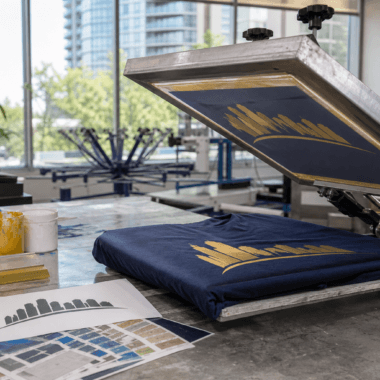
Logo screen printing buyer guide
How to Choose Logo Screen Printing That Holds Up
Short answer: Choose logo screen printing by defining the garment, quantity, print locations, artwork, colour expectations, use and deadline before asking for a quote. Request a production-ready proof that shows placement and size, identify who owns trademark permission, confirm the exact garment and care information, and get the total scope in writing. Do not assume a website category proves a specific ink, machine, minimum, turnaround or durability.
A logo can look sharp on a monitor and still disappoint on fabric when the garment texture, underbase, print size or colour expectation was never discussed. The buyer’s most important work happens before production: defining the use, checking rights, supplying good artwork and approving an unambiguous proof.
This buyer guide concentrates on selection criteria and approval controls. It does not repeat a general branding article or claim that Top Realtor Sign & Print offers an unverified material, method or deadline.
Write the job brief before choosing a printer
State garment type and colour, sizes, quantities, print locations, maximum print area, number of logo colours, required date and intended use. Separate must-haves from preferences. If garments will be supplied by the printer, request the exact brand and style before approving; if you supply them, ask whether customer-supplied goods are accepted and how spoilage is handled.
Identify one approver and one artwork source. Multiple logo versions arriving by email create avoidable errors. Keep a dated folder with the brief, artwork, proof and written changes.
Compare providers with the same criteria
| Criterion | Ask for | Red flag |
|---|---|---|
| Artwork | Accepted format and preflight process | No check before production |
| Garment | Exact style, colour and size range | Generic product description |
| Colour | How expectations and tolerances are handled | Promise of perfect screen matching |
| Proof | Placement, dimensions, colours and garment | Approval based on a small thumbnail |
| Scope | Quantity, setup, extras, timing and pickup | Incomplete verbal quote |
Prepare artwork without guessing specifications
Ask the actual printer for its preferred file format, colour mode, font handling, line-weight and minimum-detail requirements. Vector artwork can help with scaling, but it does not automatically make every detail printable. Small type, thin lines and distressed textures may need review at final size.
Confirm that you have permission to reproduce the logo. The Canadian Intellectual Property Office explains trademark information and registration, but the buyer should obtain appropriate advice for ownership and licensing questions.

Match the print decision to the garment and use
Fabric composition, weave, colour, stretch, seams and treatment can affect production choices. Ask how the specific garment changes artwork, placement or care. A heavy work shirt, lightweight promotional tee and performance fabric should not be assumed to behave the same way.
Request the manufacturer’s care information and ask whether the decoration changes it. Do not invent a wash temperature, drying method or lifespan. The Competition Bureau’s textile labelling guidance explains Canadian textile disclosure requirements; it does not verify a particular decorated garment.
Approve the production facts, not a mood board
The final approval should identify the garment, colour, sizes, quantity, logo version, print locations, dimensions, orientation and production colours. Ask how a digital proof relates to the physical result and whether a sample is available or appropriate for the job.
Screen displays, printers, inks and fabrics reproduce colour differently. Avoid promising an exact visual match unless the provider defines a measurable process and tolerance. Record every revision and do not approve from a compressed screenshot.
Read the quote and schedule carefully
Check setup, artwork work, garments, printing, extra locations, special handling, taxes, shipping or pickup, samples and changes. Confirm when timing begins: initial inquiry, payment, artwork approval, garment availability or another milestone. Ask what happens if stock changes.
Top Realtor Sign & Print provides a quote route and contact page. Use those routes to request current, job-specific capabilities and terms rather than inferring them from another product page.
Use a final pre-production checklist
- Verify logo ownership or permission.
- Lock the exact garment, colour, sizes and quantities.
- Supply the approved artwork source.
- Confirm every print location and dimension.
- Review colour expectations and limitations.
- Approve a dated proof at useful scale.
- Confirm total cost, timing and change rules.
- Retain the approval and inspect delivery promptly.
Keep a verification and decision record
Create a dated record before acting on logo screen printing. For each material point, write the question, the exact fact observed, its source, the date checked, who confirmed it and what remains uncertain. Separate a business page’s general description from a written answer about your specific product, service, transaction or appointment. Save the version you relied on because inventory, availability, terms, rules and web pages can change.
Use a simple evidence ladder. Start with current first-party information from Top Realtor Sign & Print, then check the relevant regulator, government, manufacturer or other authoritative source for claims it controls. Use an independent qualified professional when a physical condition, legal right, financial commitment, safety issue or individual need cannot be settled from documents alone. Do not turn a useful general source into proof of a business-specific fact.
- Mark every time-sensitive statement with a review date.
- Keep quotes, approvals and important changes in writing.
- Record the exact item, model, property, trip, document or service scope involved.
- List exclusions and assumptions beside the chosen option.
- Name the person responsible for the next check.
- Pause when identity, authority, safety, scope or total commitment is unclear.
This record is useful after the decision too. Compare what was promised with what was delivered, document questions promptly and retain relevant receipts or correspondence. It will not guarantee an outcome, but it reduces memory disputes and makes follow-up more precise.
Common mistakes to avoid
- Choosing by unit price before defining garment and print scope
- Assuming a web mockup is a production proof
- Sending low-resolution or conflicting logo files
- Ignoring trademark or reproduction permission
- Expecting exact screen-to-fabric colour without a defined process
- Approving placement without final dimensions
- Assuming turnaround, minimums or durability from a general service page
Frequently asked questions
What file should I send for logo screen printing?
Ask the selected printer. A vector file may be useful, but accepted formats and detail limits depend on the actual production workflow.
Can screen printing match my logo colour exactly?
Different screens, inks, garments and processes vary. Ask how colour is specified, proofed and tolerated; do not assume an exact match.
Should I order a sample?
A sample may help for a high-risk or repeat job, but availability, cost and representativeness must be confirmed with the provider.
What should I ask Top Realtor Sign & Print?
Send the garment, quantity, sizes, print locations, artwork, colour expectations, use and deadline, then request written capability, proof and quote details.
Take the next step with Top Realtor Sign & Print
Review Top Realtor Sign & Print’s printing and signage site, then use the quote route with a complete job brief. Confirm the exact garment, method, proof, timing, total and care information before approving production.
This article provides general educational information. Confirm current business details, product or service scope, laws, professional advice and individual needs before publication or action.