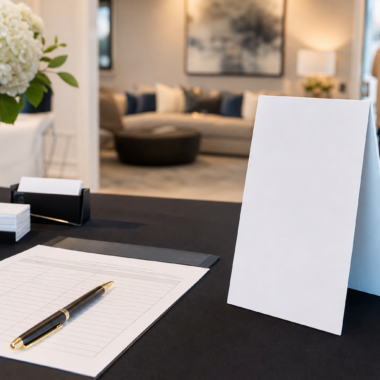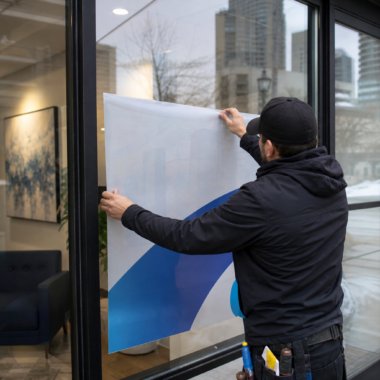

Foam board signs are useful for indoor presentations, reception displays, brokerage events, and other controlled environments. They are lightweight and practical for temporary display, but they are not automatically the right choice for an outdoor listing exposed to rain, wind, or repeated handling.
The key decision is the environment. Choose foam board for indoor or limited-exposure use, then consider PVC or coroplast when you need a more weather-resistant option. This guide explains how to compare materials, prepare artwork, check placement requirements, and order with fewer surprises.
Quick summary

- Choose foam board signs for indoor open houses, office displays, presentations, reception areas, and controlled events.
- Choose PVC or coroplast when a sign will face outdoor weather, wind, or frequent handling.
- Select the size according to viewing distance, available space, message length, and whether people will see the sign on foot or from a vehicle.
- Before ordering, confirm the substrate, mounting method, artwork, proof, production timing, and pickup or delivery arrangements.
- Check municipal and property-specific rules before installing a sign. Ontario says a permit may be required for a sign or advertising device within 400 metres of a provincial highway right-of-way.
Where foam board signs work best
Foam board is most useful when you need a rigid printed panel that is easy to move and display indoors. Real estate agents may use it for listing presentations, brokerage meetings, indoor open-house welcome areas, reception displays, or property information boards inside sales centres.
It can also suit event graphics, temporary promotional messages, indoor directional information, and branded displays for local businesses. These applications keep the sign in a controlled environment where rain, prolonged sunlight, strong wind, and rough handling are less likely to affect it.
“Temporary” does not always mean “indoors.” A foam board panel placed outside for a short event may still encounter wind, damp ground, rain, or repeated movement. Ask the printer whether the proposed substrate and finishing are appropriate instead of assuming a short display eliminates the risk.
Foam board vs. PVC vs. coroplast

The best material depends less on the message than on where the sign will be used. This comparison is a practical starting point, not a substitute for confirming the specifications of the exact product you plan to order.
| Material | Typical setting | Weather exposure | Common real estate use |
|---|---|---|---|
| Foam board | Indoor or controlled short-term displays | Use cautiously where rain, wind, or prolonged exposure is possible | Listing boards, presentations, event graphics, and reception signage |
| PVC | Outdoor or more demanding display settings | Selected when weather resistance is important | Outdoor open-house and listing signage |
| Coroplast | Outdoor temporary signage and yard applications | Commonly considered for outdoor use, subject to product specifications | Directional signs, yard signs, and short-term property promotion |
For a larger outdoor event, a product specifically presented as weather-resistant may be a better fit than foam board. Top Realtor Shop has a verified product page for 24 × 32 open house signs made from 10mm PVC. That example is not a foam board product, but it shows why the environment should guide the material choice.
How foam board fits into a real estate signage plan
A foam board panel may be one part of a broader marketing system rather than a replacement for every outdoor sign. An agent might use a rigid indoor panel for a presentation while using a weather-resistant primary sign at the property and separate directional pieces near the open house.
Think about whether you need a coordinated sign kit. A typical setup may include a main For Sale panel, a rider for a changing message such as Sold or Price Reduced, an insert panel for updated contact details or a QR code, and directional signs for an event.
This approach prevents a common ordering mistake: choosing one material for convenience and using it in locations with different demands. An indoor presentation board, roadside listing sign, and temporary directional sign may share branding without needing the same substrate.
Choose size for viewing distance and location
Start with the viewing situation, not an arbitrary dimension. A sign read by someone standing a few feet away can contain more detail than one viewed by pedestrians across a driveway or drivers approaching an intersection.
- Indoor presentation: Prioritize comfortable reading at the distance where clients will stand or sit.
- Reception display: Make the primary message visible before adding secondary details, with clear space around logos and contact information.
- Open-house event: Consider how far visitors will be from the sign and whether the message must be understood quickly while walking.
- Roadside placement: Use a product intended for the exposure and viewing conditions. Do not select foam board simply because it is lightweight.
Long phone numbers, dense property facts, and small QR codes can make a panel difficult to use. If a sign needs to communicate several things, separate the messages across a coordinated set instead of shrinking every element.
Design and artwork checks before printing
Effective sign artwork has a clear hierarchy. Put the most important message first, such as the agent or brokerage identity, property status, event direction, or desired action. Keep supporting information short and contact details easy to find.
Use strong contrast and check that the logo remains legible at the final size. Test a QR code from a printed proof or correctly scaled sample, not only from a computer screen. Keep important text and logos away from the outer edges.
Prepare the best artwork available before requesting production. A vector logo is preferable when available, while low-resolution images may become soft when enlarged. Confirm brokerage branding requirements, colours, disclosures, and contact details before approving the proof.
An online design tool may suit a simple layout, while a complex brokerage template or coordinated sign set may benefit from in-house graphic design support. Ask what file types are accepted, whether a proof is included, and whether design changes affect the schedule.
Plan mounting, handling, and exposure
Decide how the sign will be displayed before choosing the material. Will it sit on an easel, attach to a wall, hang at an event, travel between offices, or stand outside on temporary support? The answer affects the panel, mounting method, and handling requirements.
Foam board can be convenient to carry, but portability does not mean it is suitable for wind or wet conditions. Ask whether the chosen material can handle the expected exposure and whether the mounting method is appropriate. For outdoor use, confirm how the sign should be secured and stored.
Check permit and placement requirements
Requirements may vary according to the municipality, property owner, road authority, sign type, duration, and exact placement. Confirm permission before installing a sign on private property, near a roadway, or in a location with restrictions.
Ontario states that you may require a sign permit when erecting or altering a sign or advertising device on property within 400 metres of a provincial highway right-of-way. Read the Ontario sign permit guidance, then verify applicable City of Mississauga, property, brokerage, or road authority requirements.
Foam board sign ordering checklist
- Location: Is the sign indoors, outdoors, or moving between both?
- Exposure: Could it encounter rain, wind, damp ground, direct sun, or frequent handling?
- Duration: Is it needed once, for a short event, or for repeated use?
- Viewing distance: Will people read it up close, across a room, or while walking past?
- Size and message: Is there enough space without making the type too small?
- Mounting: How will it stand, hang, travel, and be stored?
- Branding and artwork: Do you have approved logos, colours, contact details, and required brokerage elements?
- Proof: Who will check spelling, phone numbers, URLs, QR codes, alignment, and colour?
- Timing: Is the selected material and quantity eligible for the required turnaround?
- Collection: Will you use local pickup or delivery?
- Permission: Have you checked property, municipal, and highway-related requirements?
A practical ordering workflow
Begin by describing the real use case rather than asking only for a material name. Tell the provider where the sign will be displayed, how long it will be used, how far away viewers will stand, and whether it may encounter weather or repeated handling.
Next, confirm the substrate, size, finishing, mounting approach, artwork requirements, and production schedule. If you are considering foam board, ask directly whether it is appropriate for the environment. If not, request a comparison with PVC, coroplast, or another suitable rigid sign option.
Submit artwork or request design help, then review the proof carefully. Top Realtor Sign & Print is a Mississauga-based provider of real estate signs and marketing materials, with local pickup and same-day options available for select products. Confirm eligibility and cutoff times for the specific order.
Frequently Asked Questions
Are foam board signs suitable for outdoor real estate listings?
They are generally better suited to indoor or controlled short-term displays. For an exposed outdoor listing, ask about PVC, coroplast, or another weather-resistant substrate.
What is the difference between foam board signs and foamcore signs?
“Foam board” and “foamcore” are commonly used as related terms for rigid, lightweight panels with a foam centre. Surface, thickness, finish, and suitability can vary, so confirm the quoted product specifications.
Should I choose foam board, PVC, or coroplast for an open house?
Choose based on exposure. Foam board may suit an indoor welcome or information display, while PVC or coroplast is generally more appropriate for outdoor directional or listing signage.
Can a printer help prepare artwork for a custom foam board sign?
Many print providers offer design assistance, and an online design tool may suit a simple layout. Confirm file preparation, proof revisions, and whether design work changes production timing.
What should I confirm before requesting same-day sign pickup?
Confirm that the exact product, material, size, quantity, and artwork qualify. Ask about cutoff times, proof approval deadlines, pickup windows, and whether design changes require more time.
Conclusion: Match the material to the environment
Foam board signs make sense for lightweight, rigid panels used indoors or in controlled short-term settings. They are not a universal substitute for outdoor real estate signage. Rain, wind, prolonged exposure, and repeated handling should prompt a conversation about PVC, coroplast, or another suitable material.
Decide where the sign will go, how it will be viewed and mounted, how long it must last, and what rules apply. Then prepare clean artwork, approve a proof, and confirm the exact product and timing with Top Realtor Sign & Print in Mississauga.